
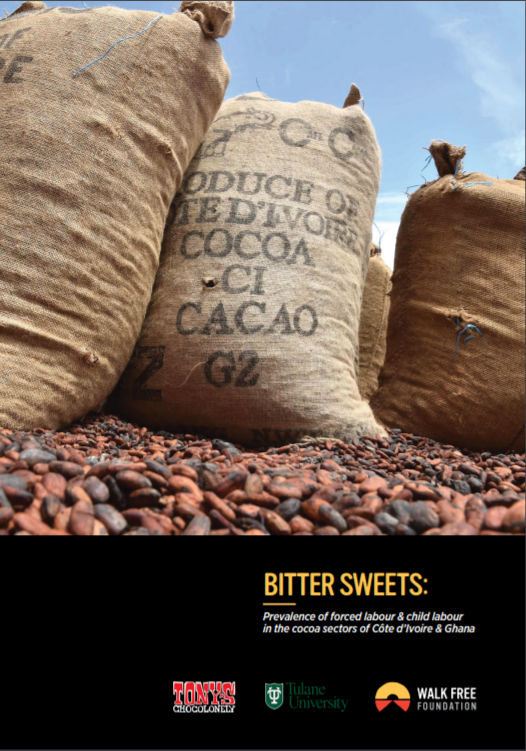
The primary aim of the study was to provide baseline estimates of prevalence of forced labour among children (aged 10-17 years) and adults (aged 18 and over) working in the cocoa sector in Ghana and Cote d’ Ivoire, as well as updated estimates of the number of children (aged 10 to 17 years) exposed to child labour.

An estimated 891,500 children aged 10 to 17 years worked in cocoa production in medium and high cocoa producing areas of Cote d’Ivoire in the year prior to the survey.

In Ghana, an estimated 708,400 children aged 10 to 17 years worked in cocoa agriculture in medium and high cocoa-growing areas in the year prior to the survey.

Bitter Sweets: Prevalence of forced labour & child labour in the cocoa sectors of Cote d'Ivoire & Ghana - Minderoo Foundation, 2018 DOWNLOAD

post

page

attachment

revision

nav_menu_item

custom_css

customize_changeset

oembed_cache

user_request

wp_block

wp_template

wp_template_part

wp_global_styles

wp_navigation

wp_font_family

wp_font_face

acf-taxonomy

acf-post-type

acf-field-group

acf-field

ai1ec_event

exactmetrics_note

National Hotline 2019 Massachusetts State Report
Graphics & InfographicsPublications

The data in this report represents signals and cases from January 1, 2019 through December 31, 2019 and is accurate as of July 30, 2020. Cases of trafficking may be ongoing or new information may revealed to the National Hotline over time. Consequen...Read More

Dutch Supermarket Supply Chains: Ending the human suffering behind our food
Publications

Inequality is rampant across the global economy, and the agro-food sector is no exception. At the top, big supermarkets and other corporate food giants dominate global food markets, allowing them to squeeze value from vast supply chains that span the...Read More

Regional Overview: Combating the Sexual Exploitation of Children in South Asia
GuidancePublications

This report maps sexual exploitation of children in travel and tourism (SECTT), online child sexual exploitation (OCSE), trafficking of children for sexual purposes, sexual exploitation of children through prostitution, child early and forced marria...Read More

Twenty Years After the Passage of the Palermo Protocol: Identifying Common Flaws in Defining Trafficking through the First Global Study of Domestic Anti-Trafficking Laws
Publications

On November 15, 2000, the United Nations adopted the Protocol to Prevent, Suppress and Punish Trafficking in Persons, Especially Women and Children (Palermo Protocol). Twenty years later, with 178 state parties, the Palermo Protocol has reached almo...Read More

TAGS: Global