Over the course of the last five years, the People’s Republic of China (PRC) government has embarked on a campaign of repression that nine governments have determined to be either “genocide” or “crimes against humanity.” The PRC has further instituted a massive state-sponsored system of forced labor throughout the Xinjiang Uyghur Autonomous Region (the XUAR or Uyghur Region). Because refusal to participate in government assistance can be considered a sign of religious extremism and punishable with internment or prison, Uyghur and other minoritized workers from the region are unable to refuse or voluntarily exit jobs assigned to them by the government. For this reason, experts have agreed that the PRC government’s programs of labor transfers and surplus labor employment transfers meet the standards of the definitions of forced labor instituted in international law and protocols. The United States legislature has found the evidence of forced labor so convincing and overwhelming that it has taken the unusual step of prohibiting the import of any product made in whole or in part in the Uyghur Region beginning in June 2022.

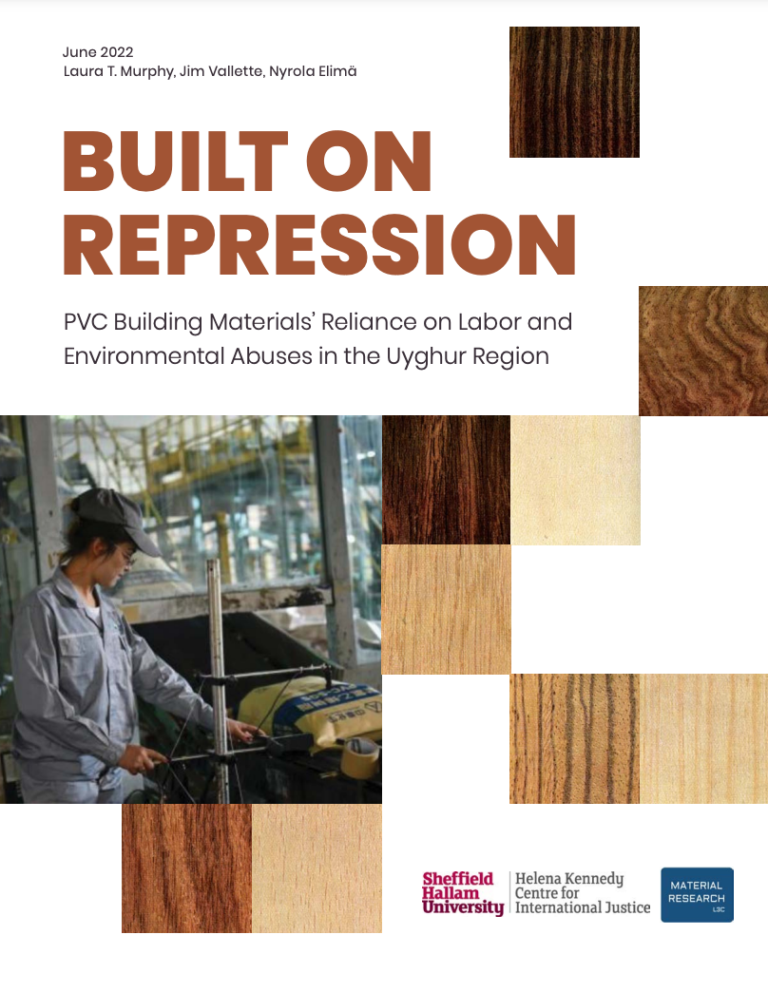
Built on repression: PVC building materials’ reliance on labor and environmental abuses in the Uyghur region - Laura T. Murphy, Jim Vallette, Nyrola Elimä (Sheffield Hallam University), June 2022 DOWNLOAD

post

page

attachment

revision

nav_menu_item

custom_css

customize_changeset

oembed_cache

user_request

wp_block

wp_template

wp_template_part

wp_global_styles

wp_navigation

wp_font_family

wp_font_face

acf-taxonomy

acf-post-type

acf-field-group

acf-field

ai1ec_event

exactmetrics_note

Understanding the Global Solar Energy Supply Chain
News & Analysis

Australians are adopting renewables quickly, at around a celebrated ten times faster than the global average. Explanations point to rising domestic electricity costs, the benefits of lots of sunshine and high homeownership, lack of red tape and fall...Read More

Downstream due diligence: Setting the record straight
News & Analysis

The due diligence expectations contained in the OECD Guidelines and United Nations Guiding Principles (UNGPs) have always, since their inception in 2011, been intended to take a risk-based approach that includes the full “value chain” of busines...Read More

TAGS:
21st Conference of the Alliance against Trafficking in Persons: ‘Confronting Demand: Tackling a root cause of trafficking in human beings’
News & AnalysisEvents

When: June 14, 2021 – June 16, 2021 all-day
Where: Online

21st Conference of the Alliance against Trafficking in Persons WHEN 14 June 2021, 14:00 – 16 June 2021, 16:30 WHERE Hofburg (Vienna, Austria) and via Zoom (upon registration) ORGANIZED BY OSCE Office of the Special Representative and Co-ordinator for Combating...

Launch of the OSCE and Tech Against Trafficking publication: Leveraging innovation to fight trafficking in human beings: A comprehensive analysis of technology tools
News & AnalysisVideosEvents

When: June 24, 2020 @ 4:30 pm – 5:30 pm

Launch of the OSCE and Tech Against Trafficking publication Leveraging innovation to fight trafficking in human beings: A comprehensive analysis of technology tools 24 June 2020 16:30-17:30 CEST | 7:30-8:30 PST | 10:30-11:30 EST via Zoom Description The intersection of...