
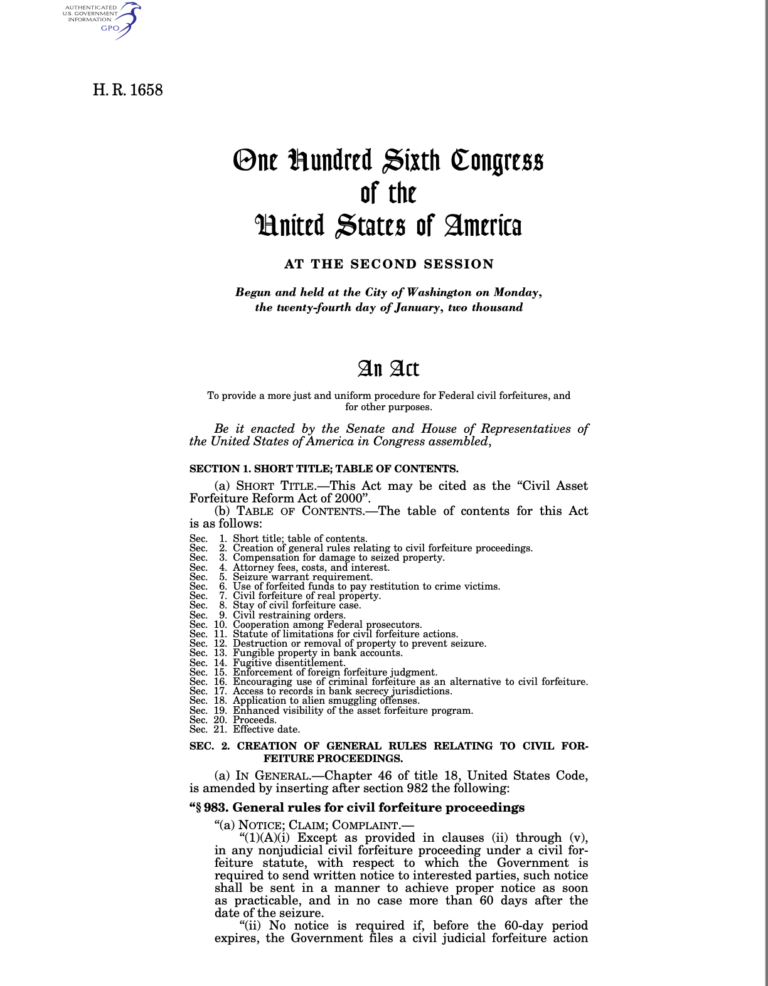
An Act to provide a more just and uniform procedure for Federal civil forfeitures, and for other purposes. Be it enacted by the Senate and House of Representatives of the United States of America in Congress assembled.

Civil Asset Forfeiture Reform Act of 2000 (CAFRA) - United States Congress, January 2000 DOWNLOAD

post

page

attachment

revision

nav_menu_item

custom_css

customize_changeset

oembed_cache

user_request

wp_block

wp_template

wp_template_part

wp_global_styles

wp_navigation

wp_font_family

wp_font_face

acf-taxonomy

acf-post-type

acf-field-group

acf-field

ai1ec_event

exactmetrics_note

Independent Anti-Slavery Commissioner Annual Report 2020-2021
GuidanceLegislationPublications

In March 2020 Delta 8.7 published an article which argued that the pandemic would impact on modern slavery in at least three ways: by heightening risks for those already exploited, increasing he risks of exploitation and disrupting response efforts....Read More

TAGS: Europe
Using Civil Litigation to Combat Human Trafficking
LegislationPublications

In October 2003, Congress passed a law allowing trafficking victims to recover civil damages from their traffickers in federal courts, 18 U.S.C. § 1595, now known as the Trafficking Victims Protection Reauthorization Act (TVPRA). In the almost twen...Read More

TAGS:
Legislating for the digital age: Global guide on improving legislative frameworks to protect children from online sexual exploitation and abuse
GuidanceLegislation

The purpose of the Global Guide is to provide guidance on how to strengthen legislative frameworks to protect children from online sexual exploitation and abuse in accordance with international and regional conventions, general comments and guidelin...Read More

TAGS:
Global Justice: Using Strategic Litigation to Combat Forced Labour
News & AnalysisStandards & Codes of ConductLegislation

Forced labor is a feature, not a bug, in today’s global economic system. Forced labor spans the globe. It involves multinational corporations. It is found in special economic zones—and war zones. And it is in everyone’s backyard. Globally, 27....Read More