
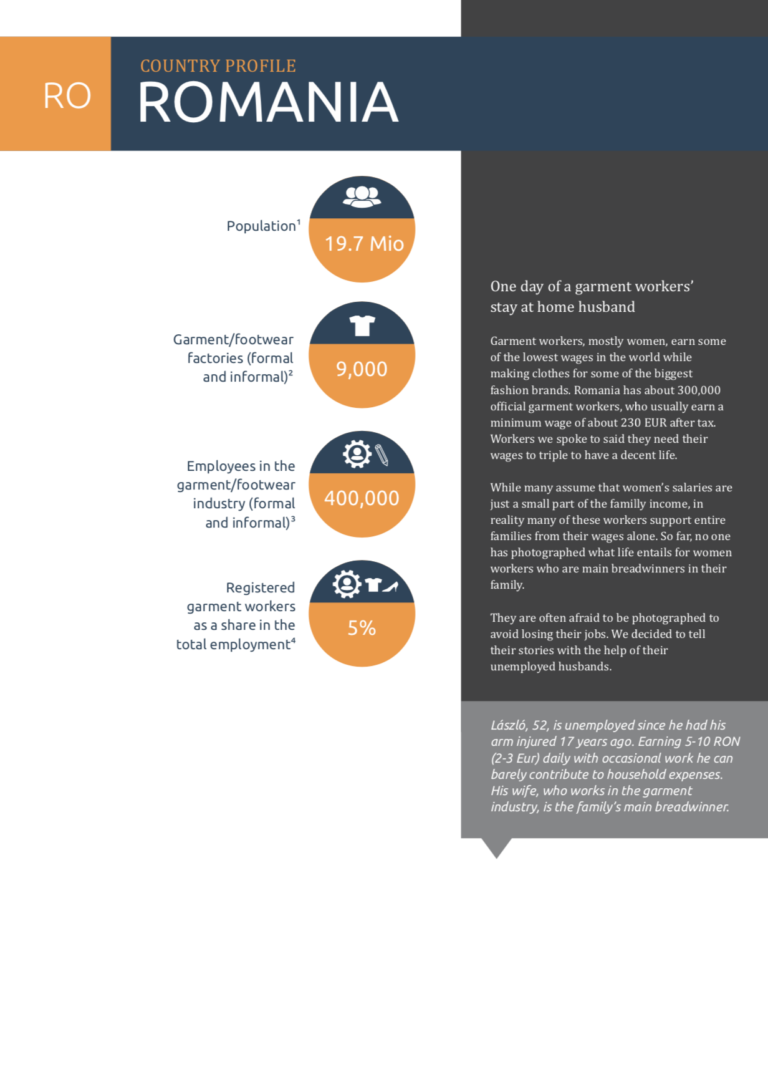
Garment workers, mostly women, earn some of the lowest wages in the world while making clothes for some of the biggest fashion brands. Romania has about 300,000 oficial garment workers, who usually earn a minimum wage of about 230 EUR after tax. Workers we spoke to said they need their wages to triple to have a decent life.

While many assume that women’s salaries are just a small part of the familly income, in reality many of these workers support entire families from their wages alone. So far, no one has photographed what life entails for women workers who are main breadwinners in their family.

They are often afraid to be photographed to avoid losing their jobs. Clean Clothes Campaign decided to tell their stories with the help of their unemployed husbands.

Country Profile: Romania - Abuses in Garment Sector DOWNLOAD

post

page

attachment

revision

nav_menu_item

custom_css

customize_changeset

oembed_cache

user_request

wp_block

wp_template

wp_template_part

wp_global_styles

wp_navigation

wp_font_family

wp_font_face

acf-taxonomy

acf-post-type

acf-field-group

acf-field

ai1ec_event

exactmetrics_note

Corporate Social Responsibility Review: Risks of Child Labor on Select Coffee Farms in Nicaragua
Publications

In Nicaragua, coffee is mainly produced on small-scale farms where temporary or seasonal work, weak remuneration, subcontracting, migrant workers, and child labor are likely to exist. In recent years, corporate social responsibility (CSR) activitie...Read More

Promoting Responsible Recovery: Detecting, Mitigating, and Remediating Modern Slavery
Publications

This briefing forms part of a broader five session series ofwebinars standing to tackle contemporary issues impactingmodern slavery in supply chains, calling for candid discussionand pragmatic solutions. ...Read More

What works to end modern slavery? A review of evidence on policy and interventions in the context of crisis
Publications

Modern slavery thrives in crisis situations. During conflicts, natural and man-made disasters, and humanitarian situations, adults and children are vulnerable to exploitation and trafficking. Conflict situations often exacerbate existing vulnerabili...Read More

Tracking Progress: Assessing Business Responses to Forced Labour and Human Trafficking in the Thai Seafood Industry
Publications

Thailand is the fourth-largest exporter of seafood globally. For over a decade, labour abuse, particularly of migrant workers from Myanmar, Cambodia, and Lao PDR, has been widely documented within the Thai seafood industry. Media exposés linking...Read More