
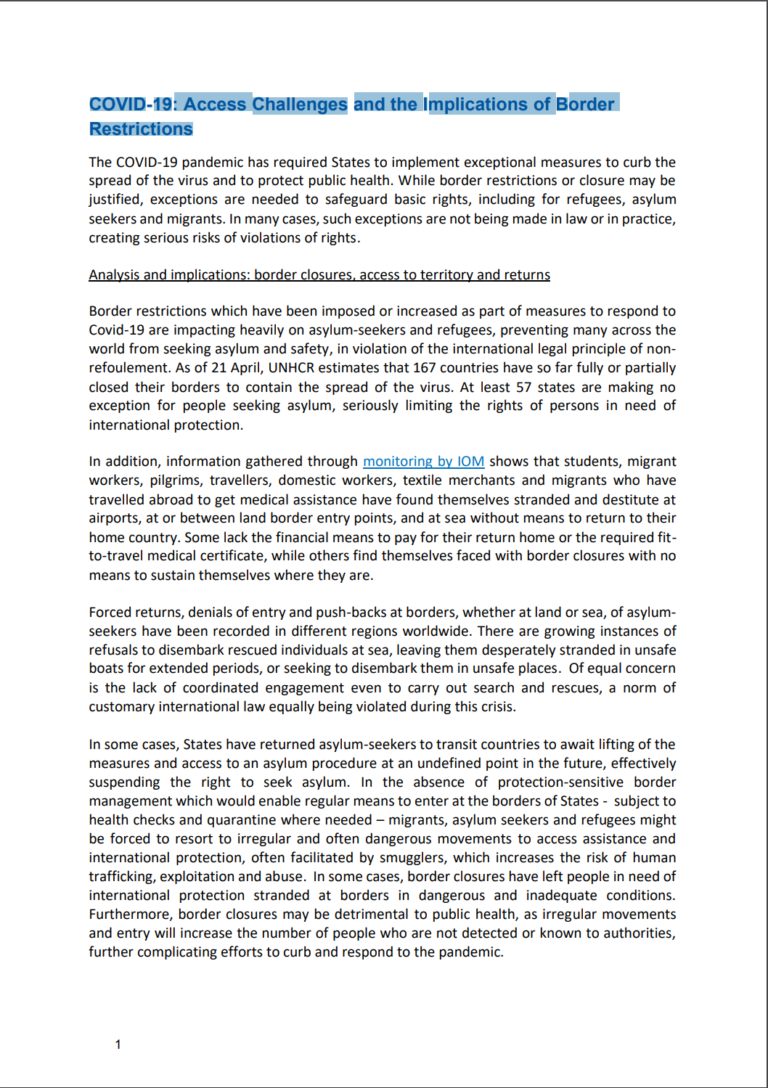
The COVID-19 pandemic has required States to implement exceptional measures to curb the spread of the virus and to protect public health. While border restrictions or closure may be justified, exceptions are needed to safeguard basic rights, including for refugees, asylum seekers and migrants. In many cases, such exceptions are not being made in law or in practice, creating serious risks of violations of rights.

COVID-19: Access Challenges and the Implications of Border Restrictions - United Nations High Commissioner for Refugees and International Organization for Migration, 2020 DOWNLOAD

post

page

attachment

revision

nav_menu_item

custom_css

customize_changeset

oembed_cache

user_request

wp_block

wp_template

wp_template_part

wp_global_styles

wp_navigation

wp_font_family

wp_font_face

acf-taxonomy

acf-post-type

acf-field-group

acf-field

ai1ec_event

exactmetrics_note

Thailand Migration Report 2019
Graphics & InfographicsPublications

The Thailand Migration Report 2019 contains 11 chapters that delve into themes such as working conditions, access to services, remittances, human trafficking and exploitation. Each chapter, written by a specific UN agency, provides up-to-date informa...Read More

Too Weak for the Job: Corporate Codes of Conduct, Non-Governmental Organizations and the Regulation of International Labour Standards
Publications

The shift of economic production from higher labour standard regimes in the global North to lower standard regimes in the South is undermining enforcement of global labour standards. Responding to criticisms from the ‘anti-sweatshop’ movement, c...Read More

Disconnected: The COVID-19 Pandemic & Call Center Workers‘ Rights in Tunisia & Morocco
COVID-19 resources

This briefing summarizes some of the key human rights risks to workers in this sector, and considers the steps taken by ten call centers operatingin and six clients outsourcing services to Tunisia and/or Morocco to protect workers amidst the crisis....Read More

TAGS:
National Hotline 2017 Alabama State Report
Graphics & InfographicsPublications

The data in this report represents signals and cases from January 1, 2017 through December 31, 2017 and is accurate as of July 11, 2018. Cases of trafficking may be ongoing or new information may be revealed to the National Hotline over time. Conseq...Read More