
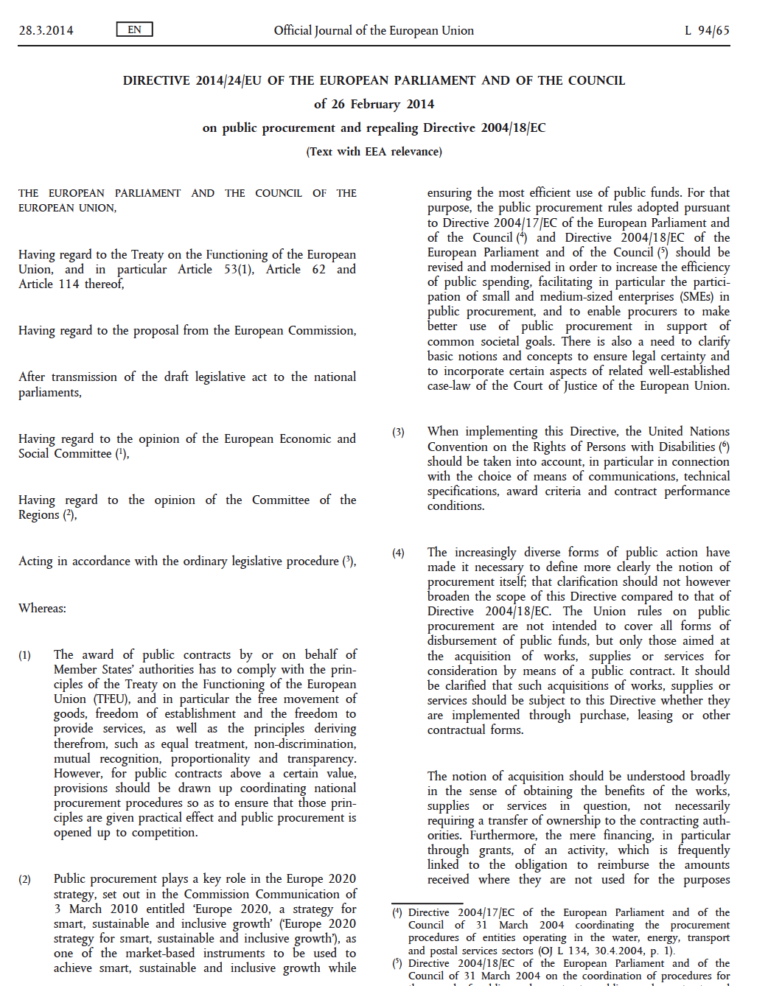
The directive sets out rules on the use of public contracts for the provision of works, supplies or services by companies or individuals and the exemptions which can be applied. The legislation specifies that when national authorities use public procurement to invite tenders to provide works, supplies or services, they must treat all applicants equally and not discriminate between them. They must also be transparent in their dealings.

Directive 2014/24/EU of the European Parliament and of the Council of 26 February 2014 on public procurement and repealing Directive 2004/18/EC - The European Union, 2014 DOWNLOAD

post

page

attachment

revision

nav_menu_item

custom_css

customize_changeset

oembed_cache

user_request

wp_block

wp_template

wp_template_part

wp_global_styles

wp_navigation

wp_font_family

wp_font_face

acf-taxonomy

acf-post-type

acf-field-group

acf-field

ai1ec_event

exactmetrics_note

Antislavery in Domestic Legislation Country Reports
Standards & Codes of ConductGood PracticesLegislationPublications

Research and analysis conducted by Katarina Schwarz (University of Nottingham) and Jean Allain (Monash University). To assess the extent to which slavery and related forms of human exploitation have been prohibited in domestic law, this project ...Read More

TAGS: Global
U.S. Executive Order 13126 of June 12, 1999
Legislation

The U.S. Executive Order 13126 on the "Prohibition of Acquisition of Products Produced by Forced or Indentured Child Labour," was signed on June 12, 1999. The Executive Order is intended to ensure that U.S. federal agencies do not procure goods mad...Read More

Legislative Scrutiny: Nationality and Borders Bill (Part 5)—Modern Slavery: Eleventh Report of Session 2021-22
Legislation

Part 5 of the Nationality and Borders Bill makes changes to the law on modern slavery. Some of the provisions place in law processes that are currently contained in policy or guidance, but often with some amendment. Other provisions amend existing s...Read More

Loi 2017-399 du 27 mars 2017 relative au devoir de vigilance des sociétés mères et des entreprises donneuses d’ordre
Legislation

French Law on the Corporate Duty of Vigilance According to the law, all companies headquartered in France and employing more than 5,000 employees in France, or headquartered in France or abroad and employing more than 10,000 employees worldwide, mus...Read More