
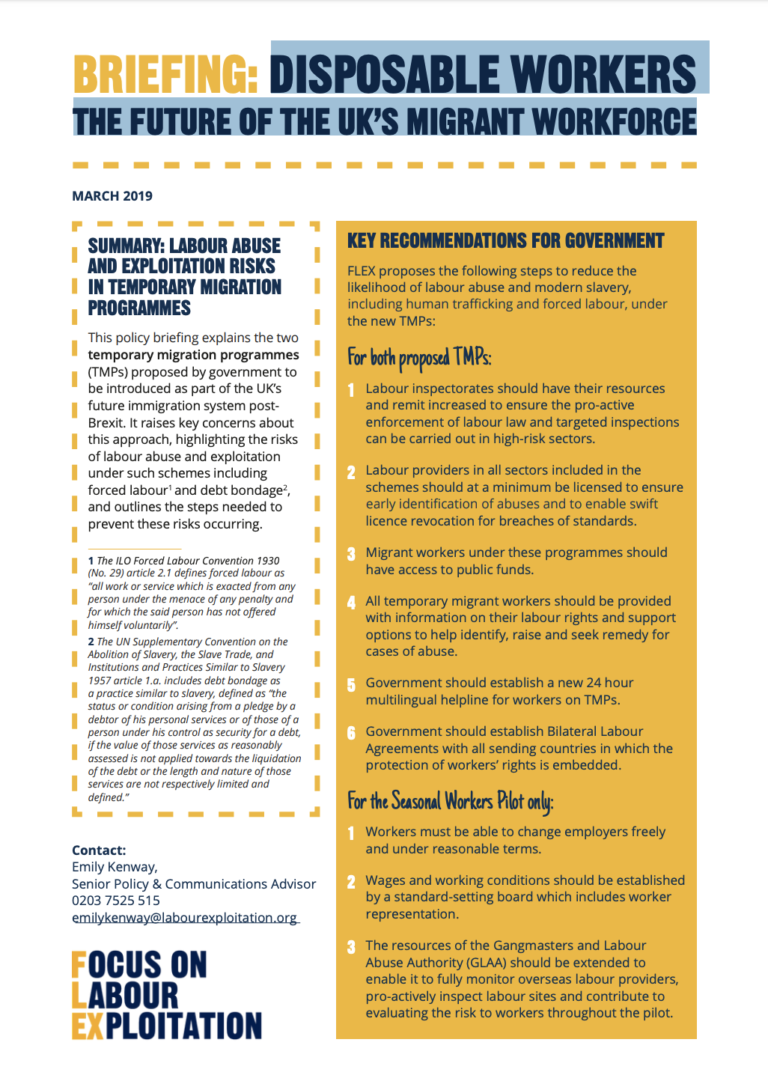
Government plans for two temporary migration programmes to bring workers to the UK after Brexit present significant risks of labour abuse and exploitation, including human trafficking.

This briefing describes the two proposed programmes, explains the risks presented by them and provides clear recommendations for government to protect workers and prevent a two-tiered labour market operating after Brexit in which temporary migrant workers are ill-treated.

Disposable Workers the Future of the UK’s Migrant Workforce - Focus on Labour Exploitation, 2019 DOWNLOAD

post

page

attachment

revision

nav_menu_item

custom_css

customize_changeset

oembed_cache

user_request

wp_block

wp_template

wp_template_part

wp_global_styles

wp_navigation

wp_font_family

wp_font_face

acf-taxonomy

acf-post-type

acf-field-group

acf-field

ai1ec_event

exactmetrics_note

National Hotline 2018 Arkansas State Report
Graphics & InfographicsPublications

The data in this report represents signals and cases from January 1, 2018 through December 31, 2018 and is accurate as of July 25, 2019. Cases of trafficking may be ongoing or new information may revealed to the National Hotline over time. Consequen...Read More

Rapid Assessment on Child Domestic Work in Myanmar
Publications

The report gives an overview of the situation of children workers in Myanmar in the domestic work sector.

Corporate Social Responsibility and Freedom of Association Rights: The Precarious Quest for Legitimacy and Control in Global Supply Chains
Publications

Corporations have increasingly turned to voluntary, multi-stakeholder governance programs to monitor workers’ rights and standards in global supply chains. This article argues that the emphasis of these programs varies significantly depending on s...Read More

Supporting Bright Futures – Young Women and Girls and Labour Migration in South-East Asia and the Pacific
Publications

At first glance, this research publication may seem niche, perhaps relevant only to “fringe” aspects of international migration. Historically, we know from decades of studies, data collection and analysis that there has been a strong bias toward...Read More