
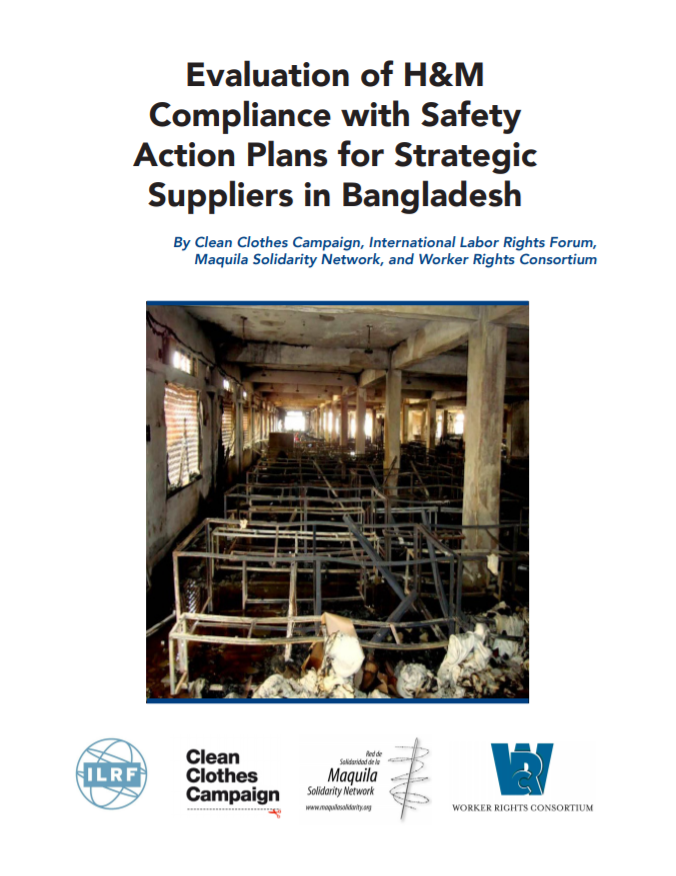
The following report evaluates and analyzes publicly available information regarding the level of progress H&M has achieved in addressing safety hazards in its factories in Bangladesh. The data is derived from factory inspection reports and Corrective Action Plans (CAPs) publicly disclosed by the Accord on Fire and Building Safety in Bangladesh and posted on the organization’s website.

Evaluation of H&M Compliance with Safety Action Plans for Strategic Suppliers in Bangladesh- Clean Clothes Campaign, International Labor Rights Forum, Maquila Solidarity Network, and Worker Rights Consortium, 2015 DOWNLOAD

post

page

attachment

revision

nav_menu_item

custom_css

customize_changeset

oembed_cache

user_request

wp_block

wp_template

wp_template_part

wp_global_styles

wp_navigation

wp_font_family

wp_font_face

acf-taxonomy

acf-post-type

acf-field-group

acf-field

ai1ec_event

exactmetrics_note

National Hotline 2018 Delaware State Report
Graphics & InfographicsPublications

The data in this report represents signals and cases from January 1, 2018 through December 31, 2018 and is accurate as of July 25, 2019. Cases of trafficking may be ongoing or new information may revealed to the National Hotline over time. Consequen...Read More

From Labour of Love to Decent Work: Protecting the Human Rights of Migrant Caregivers in Canada
Publications

This article examines Canada’s federal Live-in Caregiver Program (LCP) from the perspective of international human-rights and labour norms pertaining to the protection of migrant workers. Showing that the current legal framework of the LCP restric...Read More

Collaborating for freedom: anti-slavery partnerships in the UK
GuidancePublications

Multi-agency partnership working is often highlighted as an essential aspect of the UK public policy response to modern slavery. The Home Office’s (2014) Modern Slavery Strategy emphasises that effective partnership work is ‘crucial’ and must ...Read More

Employing North Korean Workers in the Czech Republic
Publications

Between 1998 and 2008, several hundred North Koreans worked for roughly ten Czech companies. They were mostly young women employed in the shoemaking, textile, and food industries. Initially, their presence attracted little attention from the media o...Read More