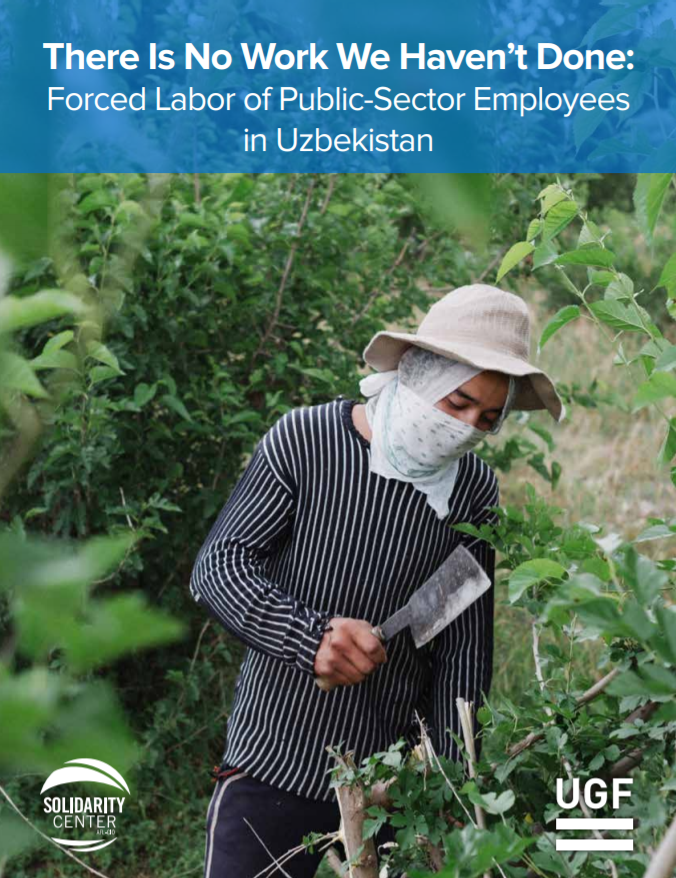
Although the government of Uzbekistan has made progress on ending child and adult forced labour in the cotton fields after more than a decade of international pressure, a new report finds that forced labour remains rampant in other arenas of Uzbek life, affecting public-sector workers in particular.

This report is based on 62 in-depth interviews and approximately 200 brief interviews with education and medical professionals, other public-sector employees, farmers and schoolchildren conducted by UGF monitors between May 15 and July 15, 2018, and supplemented with media reports. The in-depth interviews were conducted with 34 men and 25 women between the ages of 21 and 58, and three children, ages 13 and 14. The brief interviews included 50 public-sector employees, 30 of whom work in education. The remaining 20 public-sector employees included nine medical workers, eight employees of state agencies, two state bank employees and one state factory worker. UGF monitors also interviewed three children, seven farmers, one market employee and one inmate of a low-security prison colony where prisoners work outside the facility.

Forced Labor of Public-Sector Employees in Uzbekistan - The Solidarity Center, 2019 DOWNLOAD

post

page

attachment

revision

nav_menu_item

custom_css

customize_changeset

oembed_cache

user_request

wp_block

wp_template

wp_template_part

wp_global_styles

wp_navigation

wp_font_family

wp_font_face

acf-taxonomy

acf-post-type

acf-field-group

acf-field

ai1ec_event

exactmetrics_note

“The Harvest is in My Blood”: Hazardous Child Labor in Tobacco Farming in Indonesia
Publications

This report documents how child tobacco workers are exposed to nicotine, handle toxic chemicals, use sharp tools, lift heavy loads, and work in extreme heat. Their work could have lasting consequences for their health and development. It also discus...Read More

Measurement Action Freedom – An independent assessment of government progress towards achieving UN Sustainable Development Goal 8.7
Publications

No country in the word is exempt from modern slavery. Regardless of size, population or wealth, this insidious crime permeates national borders and global supply chains. Even in countries with seemingly strong laws and systems, there are critica...Read More

TAGS: Global
Supermarket Responsibilities for Supply Chain Workers’ Rights – Continuing Challenges in Seafood Supply Chains and the Case for Stronger Supermarket Action
Publications

International food supply chains provide employment for tens of millions of women and men around the world, demonstrating the potential for private sector actors to fight poverty and inequality. Yet far too many work in appalling conditions. The o...Read More

Increased Transparency of Forced Labour and Money Laundering in Seafood Supply Chains
Publications

This briefing paper by Liberty Shared sets out recent improvements to the transparency of supply chains and analysis techniques and resources being increasingly applied by civil society to identify where exploitative activities exist in a supply chai...Read More