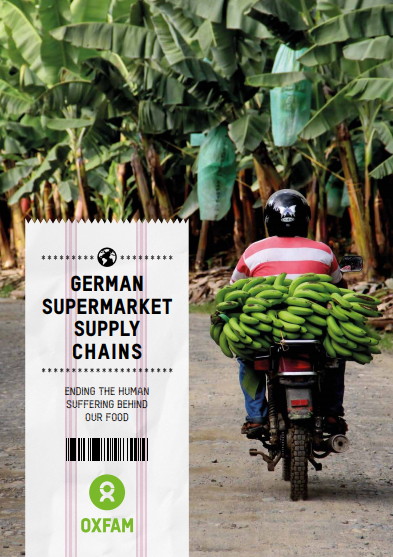
Inequality is rampant across the global economy, and the agro-food sector is no exception. At the top, big supermarkets and other corporate food giants dominate global food markets, allowing them to squeeze value from vast supply chains that span the globe, while at the bottom the bargaining power of small-scale farmers and workers has been steadily eroded in many of the countries from which German supermarkets and others from around the world source. The result is widespread human suffering among the women and men producing our food.

This report puts key findings of the global campaign report Ripe for Change: Ending human suffering in supermarket supply chains in a German context.

German Supermarket Supply Chains: Ending the human suffering behind our food - Oxfam Germany, 2018 DOWNLOAD

post

page

attachment

revision

nav_menu_item

custom_css

customize_changeset

oembed_cache

user_request

wp_block

wp_template

wp_template_part

wp_global_styles

wp_navigation

wp_font_family

wp_font_face

acf-taxonomy

acf-post-type

acf-field-group

acf-field

ai1ec_event

exactmetrics_note

Supermarket Responsibilities for Supply Chain Workers’ Rights – Continuing Challenges in Seafood Supply Chains and the Case for Stronger Supermarket Action
Publications

International food supply chains provide employment for tens of millions of women and men around the world, demonstrating the potential for private sector actors to fight poverty and inequality. Yet far too many work in appalling conditions. The o...Read More

National Hotline 2016: Puerto Rico Report
Publications

The following information is based on incoming communication with the National Human Trafficking Hotline from January 1, 2016 – December 31, 2016 about human trafficking cases and issues related to human trafficking in Puerto Rico.  ...Read More

Climate-induced migration and modern slavery
Publications

Climate change is devastating the planet, leading to intensifying global inequality as well as disputes over land, water, and scarce resources. People are being driven to migrate within and across borders in search of resources and income, making th...Read More

Looking for a Quick Fix – How Weak Social Auditing is Keeping Workers in Sweatshops
Publications

This report from 2005 researches the weaknesses of social auditing. Social audits to check working conditions in production facilities emerged in the mid-1990s after a number of high profile companies were widely scrutinized for substandard working ...Read More