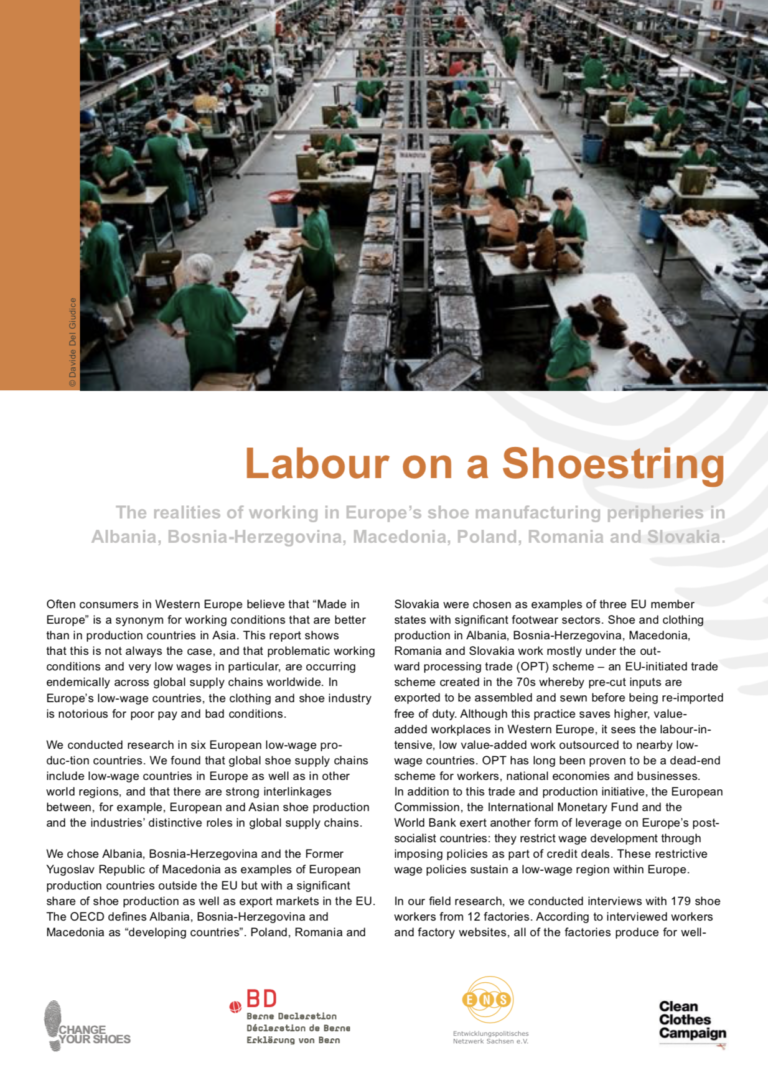
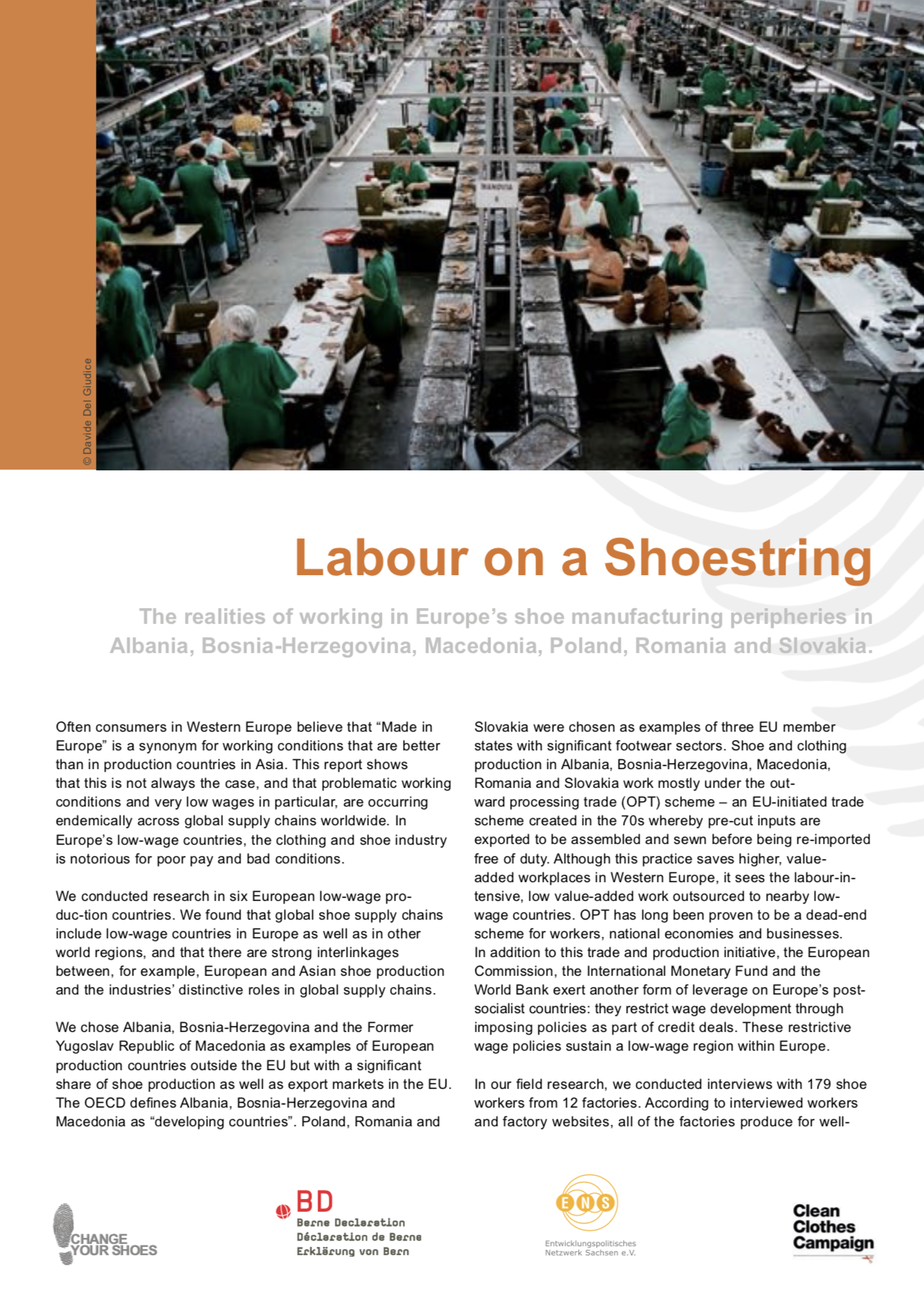
Often consumers in Western Europe believe that “Made in Europe” is a synonym for working conditions that are better than in production countries in Asia. This report shows that this is not always the case, and that problematic working conditions and very low wages in particular, are occurring endemically across global supply chains worldwide. In Europe’s low-wage countries, the clothing and shoe industry is notorious for poor pay and bad conditions.

They conducted research in six European low-wage production countries. They found that global shoe supply chains include low-wage countries in Europe as well as in other world regions, and that there are strong interlinkages between, for example, European and Asian shoe production and the industries’ distinctive roles in global supply chains.

Labour on a Shoestring: The Realities of Working in Europe’s Shoe Manufacturing Peripheries in Albania, Bosnia-Herzegovina, Macedonia, Poland, Romania and Slovakia DOWNLOAD

post

page

attachment

revision

nav_menu_item

custom_css

customize_changeset

oembed_cache

user_request

wp_block

wp_template

wp_template_part

wp_global_styles

wp_navigation

wp_font_family

wp_font_face

acf-taxonomy

acf-post-type

acf-field-group

acf-field

ai1ec_event

exactmetrics_note

Country Profile: Romania – Abuses in Garment Sector
Publications

Garment workers, mostly women, earn some of the lowest wages in the world while making clothes for some of the biggest fashion brands. Romania has about 300,000 oficial garment workers, who usually earn a minimum wage of about 230 EUR after tax. Wor...Read More

Impact of the CARE Tipping Point Program in Nepal on adolescent girls’ agency and risk of child, early, or forced marriage: Results from a cluster-randomized controlled trial
Publications

ackground: Girl child, early, and forced marriage (CEFM) persists in South Asia, with long-term effects on well- being. CARE’s Tipping Point Initiative (TPI) sought to address the gender norms and inequalities underlying CEFM by engaging part...Read More

TAGS:
Are child domestic workers worse off than their peers? Comparing children in domestic work, child marriage, and kinship care with biological children of household heads: Evidence from Zimbabwe
Publications

Child domestic work is a hidden form of child labour driven by poverty and social norms. However, little is known about the situations of child domestic workers. This study aims to describe and analyse gender-specific working conditions, health, and...Read More

Refugee protection, human smuggling, and trafficking in Bangladesh and Southeast Asia
Publications

The ‘Protecting Rohingya Refugees in Asia’ project brings together the Danish Refugee Council, the Asia Displacement Solutions Platform, the Mixed Migration Centre, Jesuit Refugee Service (JRS) Indonesia, HOST International, and the Geutanyoë F...Read More

TAGS: