
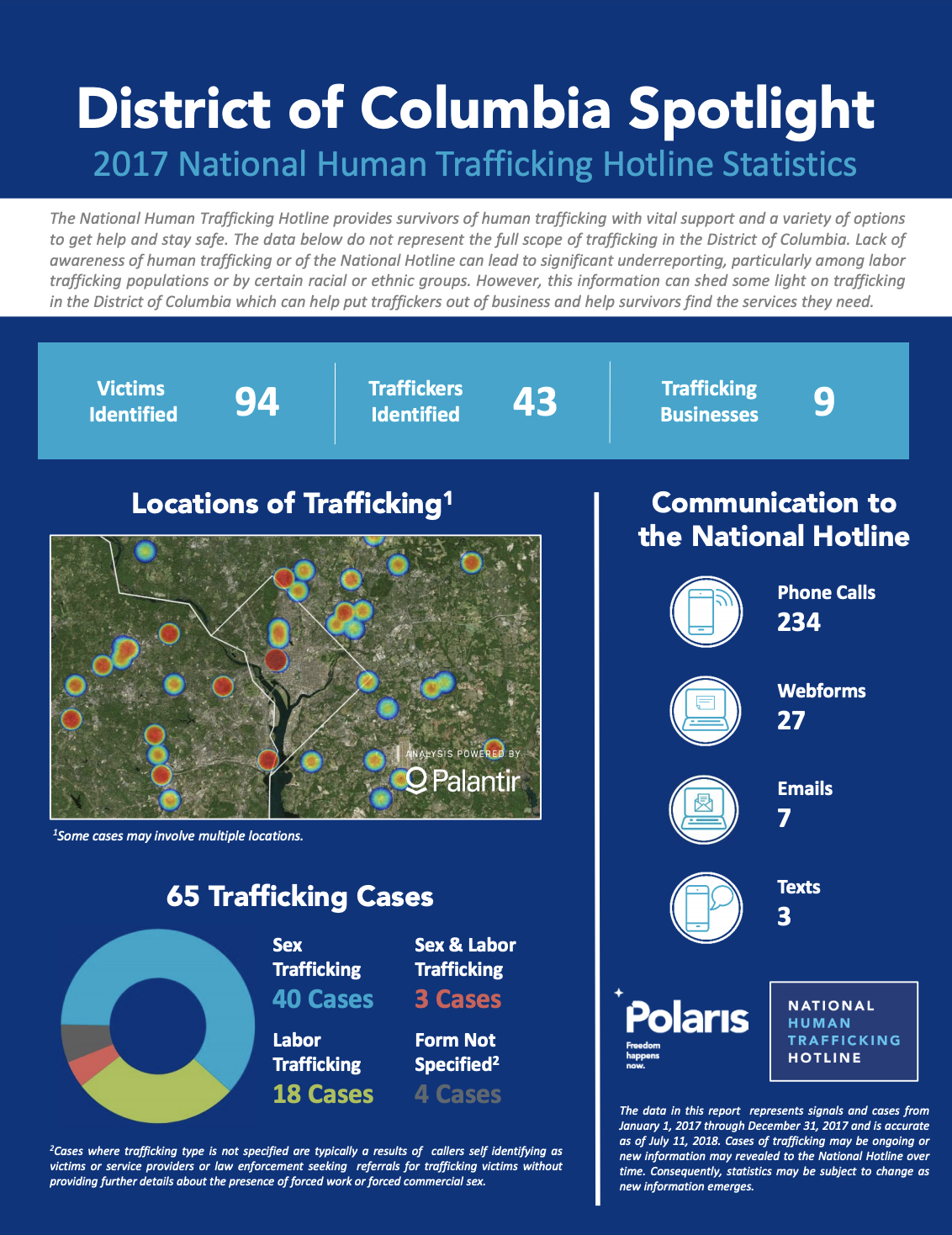
The data in this report represents signals and cases from January 1, 2017 through December 31, 2017 and is accurate as of July 11, 2018. Cases of trafficking may be ongoing or new information may be revealed to the National Hotline over time. Consequently, statistics may be subject to change as new information emerges.

You can download the report infographic below.

National Hotline 2017 District of Columbia State Report - National Human Trafficking Hotline, 2018 DOWNLOAD

post

page

attachment

revision

nav_menu_item

custom_css

customize_changeset

oembed_cache

user_request

wp_block

wp_template

wp_template_part

wp_global_styles

wp_navigation

wp_font_family

wp_font_face

acf-taxonomy

acf-post-type

acf-field-group

acf-field

ai1ec_event

exactmetrics_note

Human Trafficking and Risky Migration Routes Data Collection: A case study from Kenya
Publications

In August, 2019, Stop the Traffik Kenya (STTK) and Freedom Collaborative (FC), a project operated by Liberty Shared, launched a data collection effort with civil society organisations (CSOs) in Kenya to report known human trafficking and high-risk m...Read More

TAGS: Africa
Human rights impacts of Nordic investments in renewable energy developments in the Global South
Publications

The climate emergency poses a huge threat to human rights. In order to address the climate crisis, a transition to an economy respectful of the planet is urgently required. As part of this green transition, moving away from fossil energy sources, to...Read More

The Climate Change–Human Trafficking Nexus
Good PracticesPublications

Climate change increases the risk of natural disasters and places a strain on livelihoods. This may contribute to high-risk behaviours and other negative coping strategies among affected populations, such as resorting to unscrupulous recruitment age...Read More

TAGS: Asia
Supermarket Responsibilities for Supply Chain Workers’ Rights – Continuing Challenges in Seafood Supply Chains and the Case for Stronger Supermarket Action
Publications

International food supply chains provide employment for tens of millions of women and men around the world, demonstrating the potential for private sector actors to fight poverty and inequality. Yet far too many work in appalling conditions. The o...Read More