
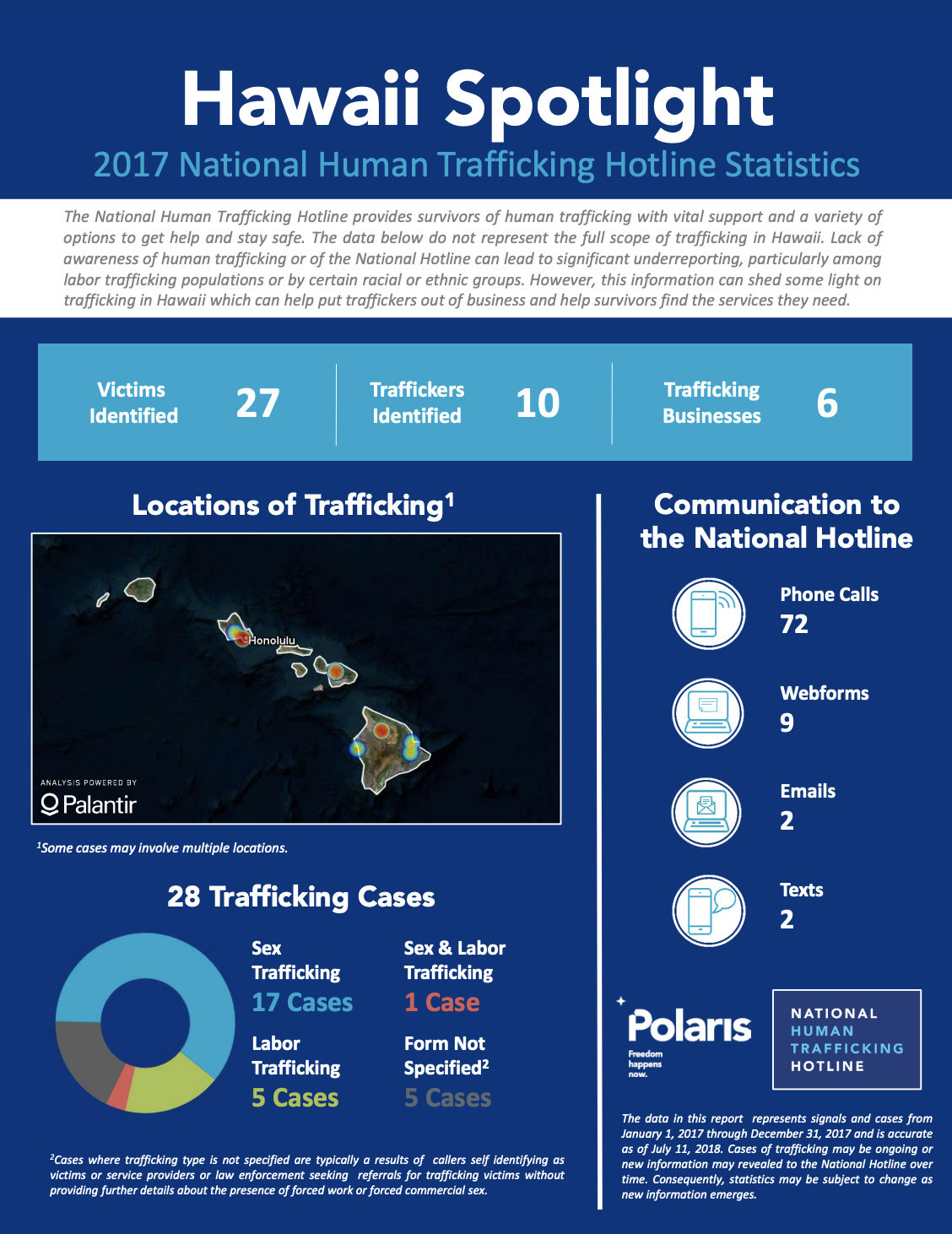
The data in this report represents signals and cases from January 1, 2017 through December 31, 2017 and is accurate as of July 11, 2018. Cases of trafficking may be ongoing or new information may be revealed to the National Hotline over time. Consequently, statistics may be subject to change as new information emerges.

You can download the report infographic below.

National Hotline 2017 Hawaii State Report - National Human Trafficking Hotline, 2018 DOWNLOAD

post

page

attachment

revision

nav_menu_item

custom_css

customize_changeset

oembed_cache

user_request

wp_block

wp_template

wp_template_part

wp_global_styles

wp_navigation

wp_font_family

wp_font_face

acf-taxonomy

acf-post-type

acf-field-group

acf-field

ai1ec_event

exactmetrics_note

Special Issue – Migration, Sexuality, and Gender Identity
Publications

This special issue of Anti-Trafficking Review bridges the fields of queer and transgender studies, migration studies, research on sex work, and critiques of the discourse on human trafficking. Along with centring LGBTQI+ subjects as actors within th...Read More

TAGS: Global
Modern Slavery in Pacific Supply Chains of Canned Tuna
Publications

Between November 2018 and January 2019, Business & Human Rights Resource Centre invited 35 canned tuna companies and supermarkets - representing 80 of the world’s largest retail canned tuna brands - to answer a survey on their approach to hu...Read More

Catching the Virus Cybercrime, Disinformation and the COVID-19 Pandemic
COVID-19 resourcesPublications

Cybercriminals have been among the most adept at exploiting the COVID-19 pandemic for the various scams and attacks they carry out. With a record number of potential victims staying at home and using online services across the European Union (EU) du...Read More

Point of No Returns Part II – Human Rights: An assessment of asset managers’ approaches to human and labour rights
Publications

The number of modern slavery victims in global supply chains today is believed to stand at around 16 million, roughly the same number of enslaved people as during the transatlantic slave trade in the 18th century. While this statistic alone is sugge...Read More