
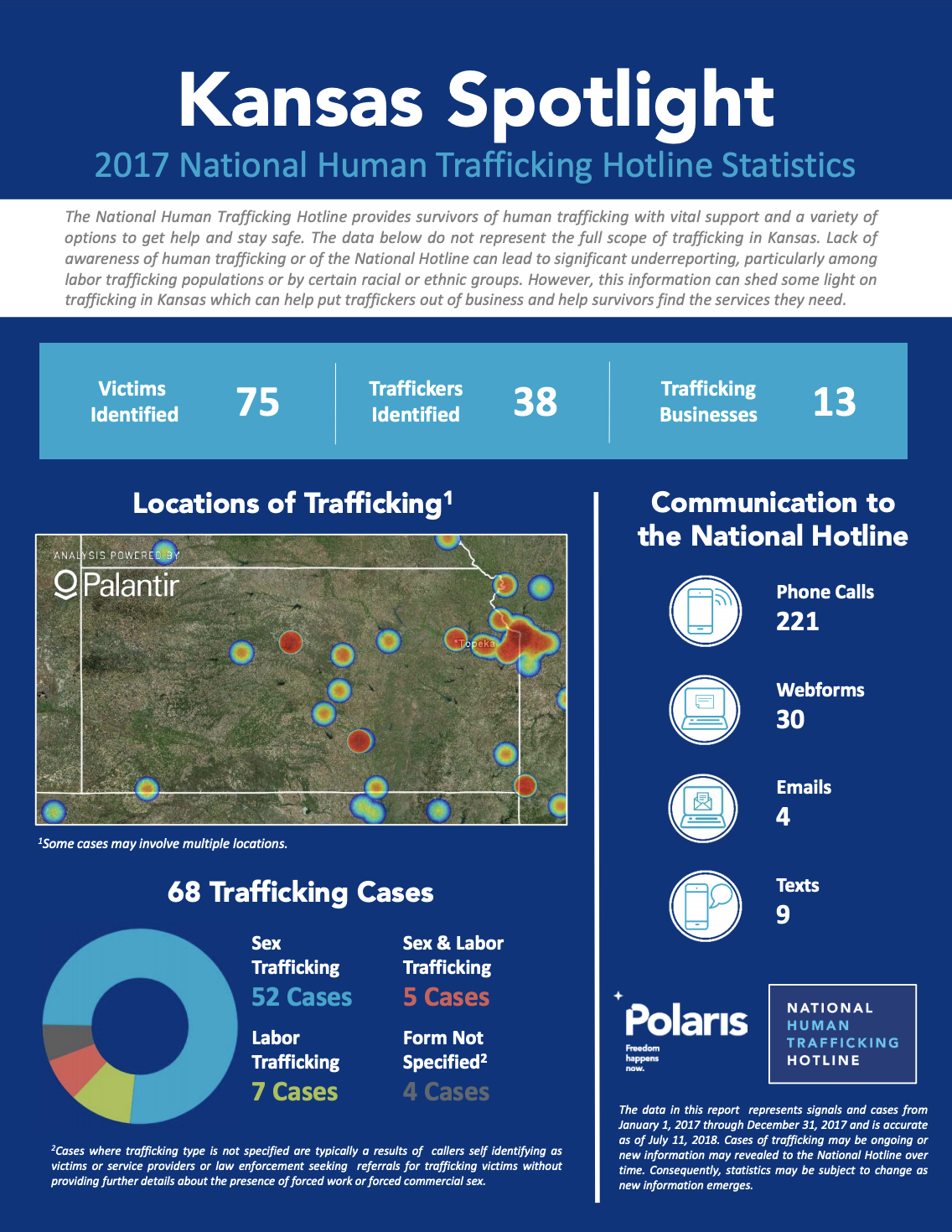
The data in this report represents signals and cases from January 1, 2017 through December 31, 2017 and is accurate as of July 11, 2018. Cases of trafficking may be ongoing or new information may be revealed to the National Hotline over time. Consequently, statistics may be subject to change as new information emerges.

You can download the report infographic below.

National Hotline 2017 Kansas State Report - National Human Trafficking Hotline, 2018 DOWNLOAD

post

page

attachment

revision

nav_menu_item

custom_css

customize_changeset

oembed_cache

user_request

wp_block

wp_template

wp_template_part

wp_global_styles

wp_navigation

wp_font_family

wp_font_face

acf-taxonomy

acf-post-type

acf-field-group

acf-field

ai1ec_event

exactmetrics_note

Promoting Responsible Recovery: Detecting, Mitigating, and Remediating Modern Slavery
Publications

This briefing forms part of a broader five session series ofwebinars standing to tackle contemporary issues impactingmodern slavery in supply chains, calling for candid discussionand pragmatic solutions. ...Read More

Rapid assessment of children in child labour in Honiara, Solomon Islands
Publications

The Rapid Assessment of Children in Child Labour in Honiara, Solomon Islands, was commissioned by the International Labour Organization (ILO) in response to concerns raised at the first National Child Labour and Trafficking Forum in Honiara in Augu...Read More

Defining the Gap: Data Collection on Trafficking in Human Beings and Exploitation in Germany –The Civil Society Approach of the KOK
Publications

The collection of empirical data on the phenomenon of trafficking in human beings and exploitation is essential in determining the extent of this human rights violation, as well as in deriving from the findings policies and measures for the protecti...Read More

TAGS: Europe
Assessing Labor Risk for Workers Migrating from the Philippines to Europe
GuidancePublications

Millions of people from the Philippines have migrated abroad for employment, seeking a better life and improved economic status for themselves and their families. Today, over 10 million Filipinos are estimated to live and work internationally, with ...Read More