
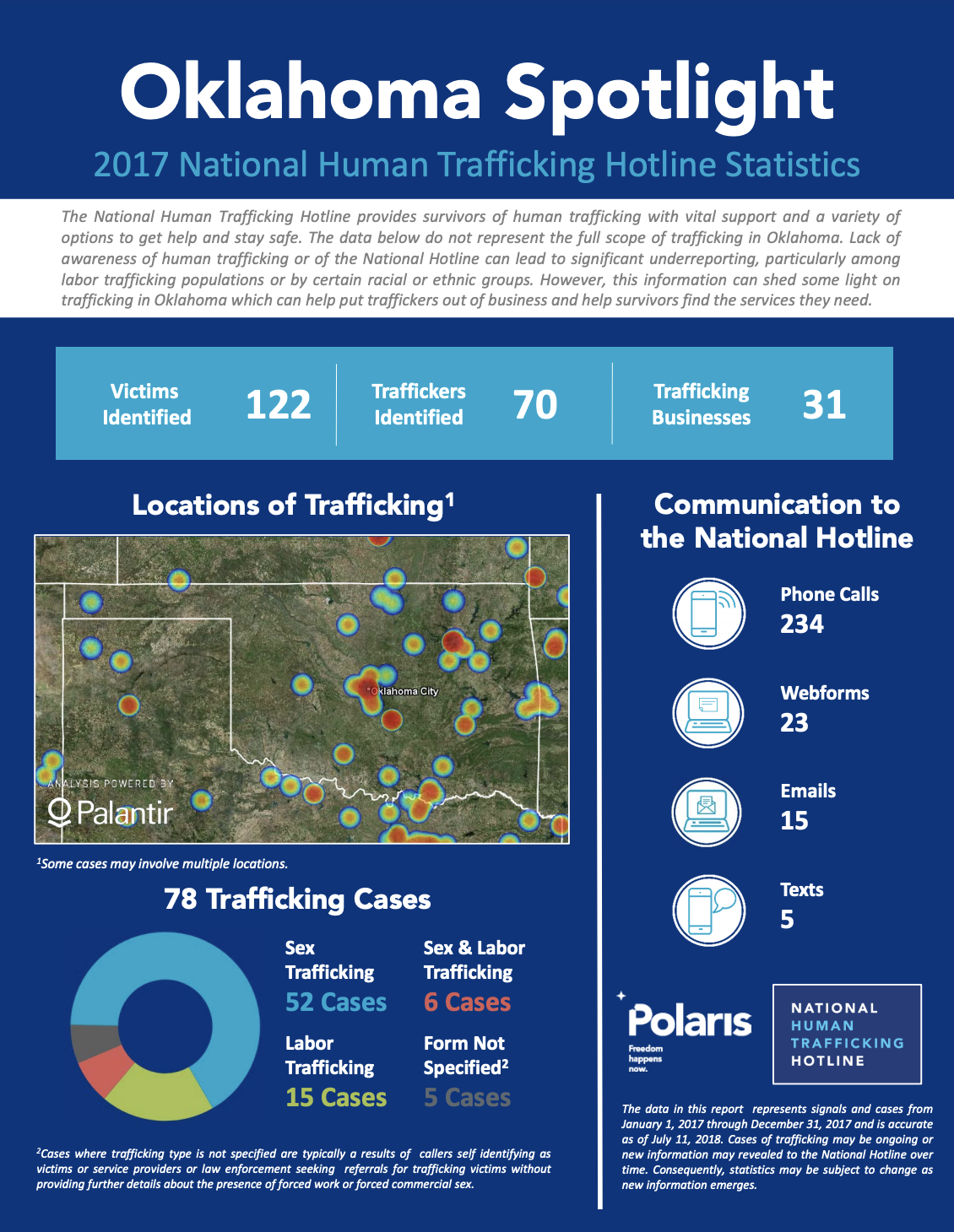
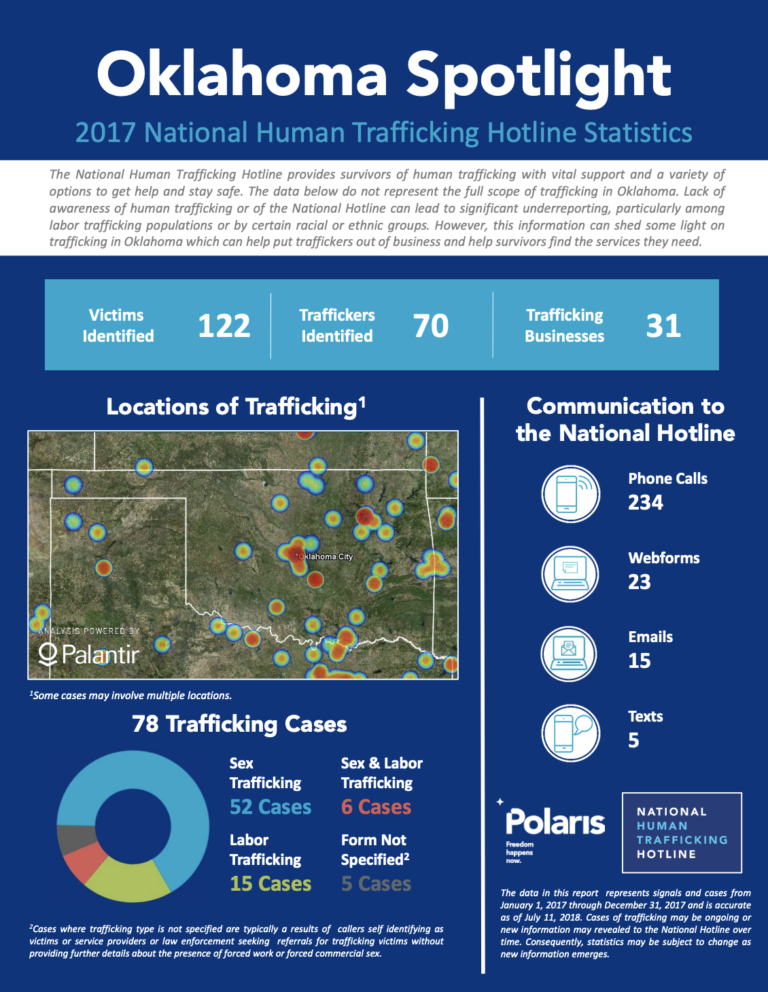
The data in this report represents signals and cases from January 1, 2017 through December 31, 2017 and is accurate as of July 11, 2018. Cases of trafficking may be ongoing or new information may be revealed to the National Hotline over time. Consequently, statistics may be subject to change as new information emerges.

You can download the report infographic below.

National Hotline 2017 Oklahoma State Report - National Human Trafficking Hotline, 2018 DOWNLOAD

post

page

attachment

revision

nav_menu_item

custom_css

customize_changeset

oembed_cache

user_request

wp_block

wp_template

wp_template_part

wp_global_styles

wp_navigation

wp_font_family

wp_font_face

acf-taxonomy

acf-post-type

acf-field-group

acf-field

ai1ec_event

exactmetrics_note

Leveraging innovation to fight trafficking in human beings: a comprehensive analysis of technology tools
News & AnalysisPublications

The publication takes stock of technology tools and initiatives developed to combat trafficking in human beings in its different forms in the OSCE area and beyond. It also examines the ways technology can be misused to facilitate trafficking in huma...Read More

Twenty Years After the Passage of the Palermo Protocol: Identifying Common Flaws in Defining Trafficking through the First Global Study of Domestic Anti-Trafficking Laws
Publications

On November 15, 2000, the United Nations adopted the Protocol to Prevent, Suppress and Punish Trafficking in Persons, Especially Women and Children (Palermo Protocol). Twenty years later, with 178 state parties, the Palermo Protocol has reached almo...Read More

TAGS: Global
National Hotline 2018 Massachusetts State Report
Graphics & InfographicsPublications

The data in this report represents signals and cases from January 1, 2018 through December 31, 2018 and is accurate as of July 25, 2019. Cases of trafficking may be ongoing or new information may revealed to the National Hotline over time. Consequen...Read More

At Risk of Forced Labour?
Publications

This small-scale exploratory study aims to understand whether certain categories of workers in the textile and apparel sector in the National Capital Region in India are at any risk of forced labour, and, if so, the nature and incidence of these ris...Read More