
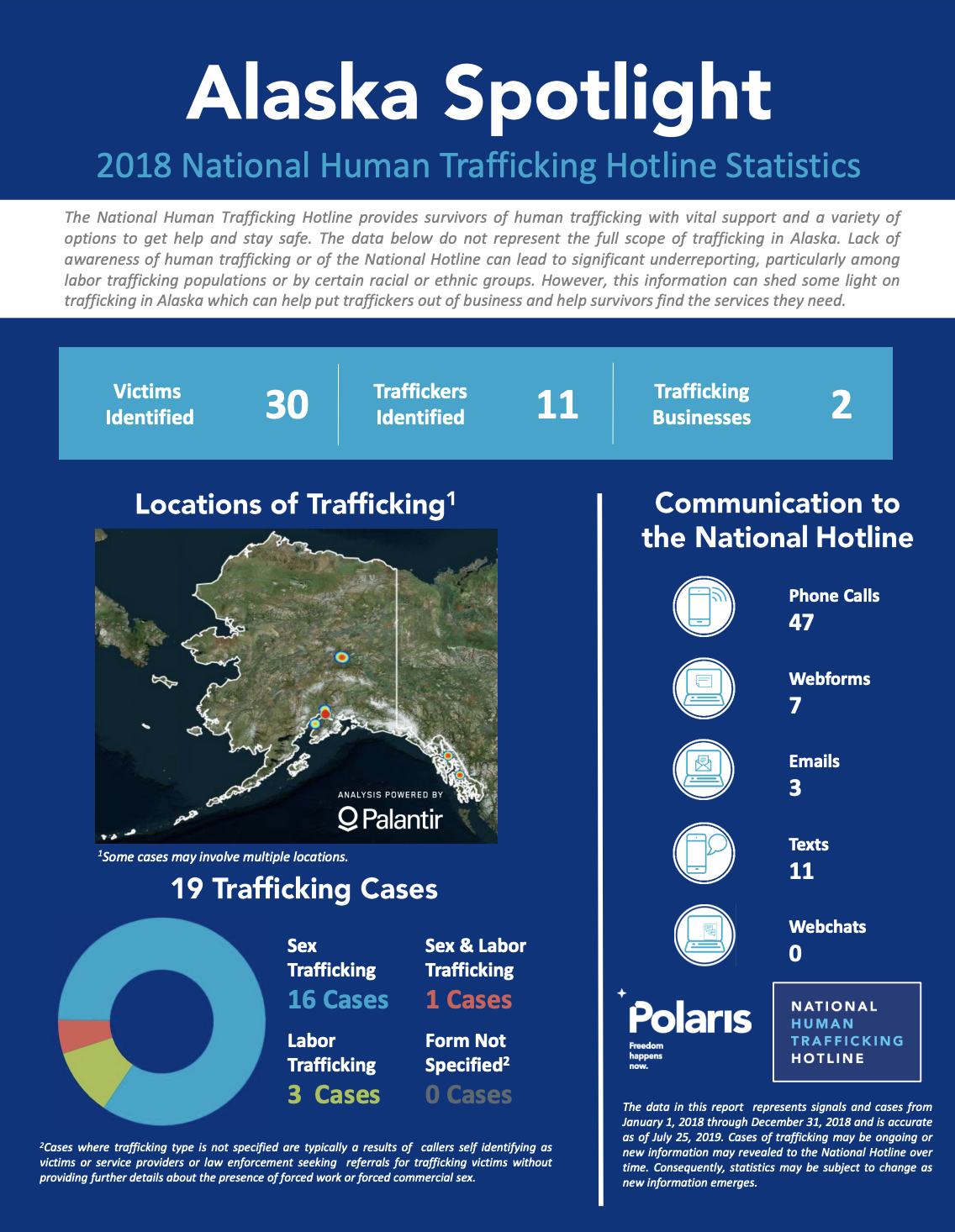
The data in this report represents signals and cases from January 1, 2018 through December 31, 2018 and is accurate as of July 25, 2019. Cases of trafficking may be ongoing or new information may revealed to the National Hotline over time. Consequently, statistics may be subject to change as new information emerges.

You can download the report infographic below.

National Hotline 2018 Alaska State Report - National Human Trafficking Hotline, 2019 DOWNLOAD

post

page

attachment

revision

nav_menu_item

custom_css

customize_changeset

oembed_cache

user_request

wp_block

wp_template

wp_template_part

wp_global_styles

wp_navigation

wp_font_family

wp_font_face

acf-taxonomy

acf-post-type

acf-field-group

acf-field

ai1ec_event

exactmetrics_note

National Hotline 2016: Puerto Rico Report
Publications

The following information is based on incoming communication with the National Human Trafficking Hotline from January 1, 2016 – December 31, 2016 about human trafficking cases and issues related to human trafficking in Puerto Rico.  ...Read More

A Call to Action: Ending the Use of All Forms of Child Labour in Supply Chains
Publications

This report offers seven recommendations, such as developing incentives for businesses to thoroughly and continually monitor their supply chains for the use of child labour and forced labour, and to share best practices. It also recommends the Gover...Read More

A protective environment for children in Côte d’Ivoire cocoa-growing communities: Public-Private Partnership
Graphics & Infographics

Mars Inc. has teamed up with a range of partners in Côte d’Ivoire to help farmers produce better crops and increase their incomes; to help communities improve their living standards; and to fight child labour by making sure children go to school...Read More

Fishing For Data
Publications

Marine fisheries are critical resources for coastal developing countries. They are also difficult to manage sustainably. Almost a third of global fish stocks are degraded from overfishing, and a further 60% are ‘fully exploited’ (FAO, 2016). Ille...Read More