
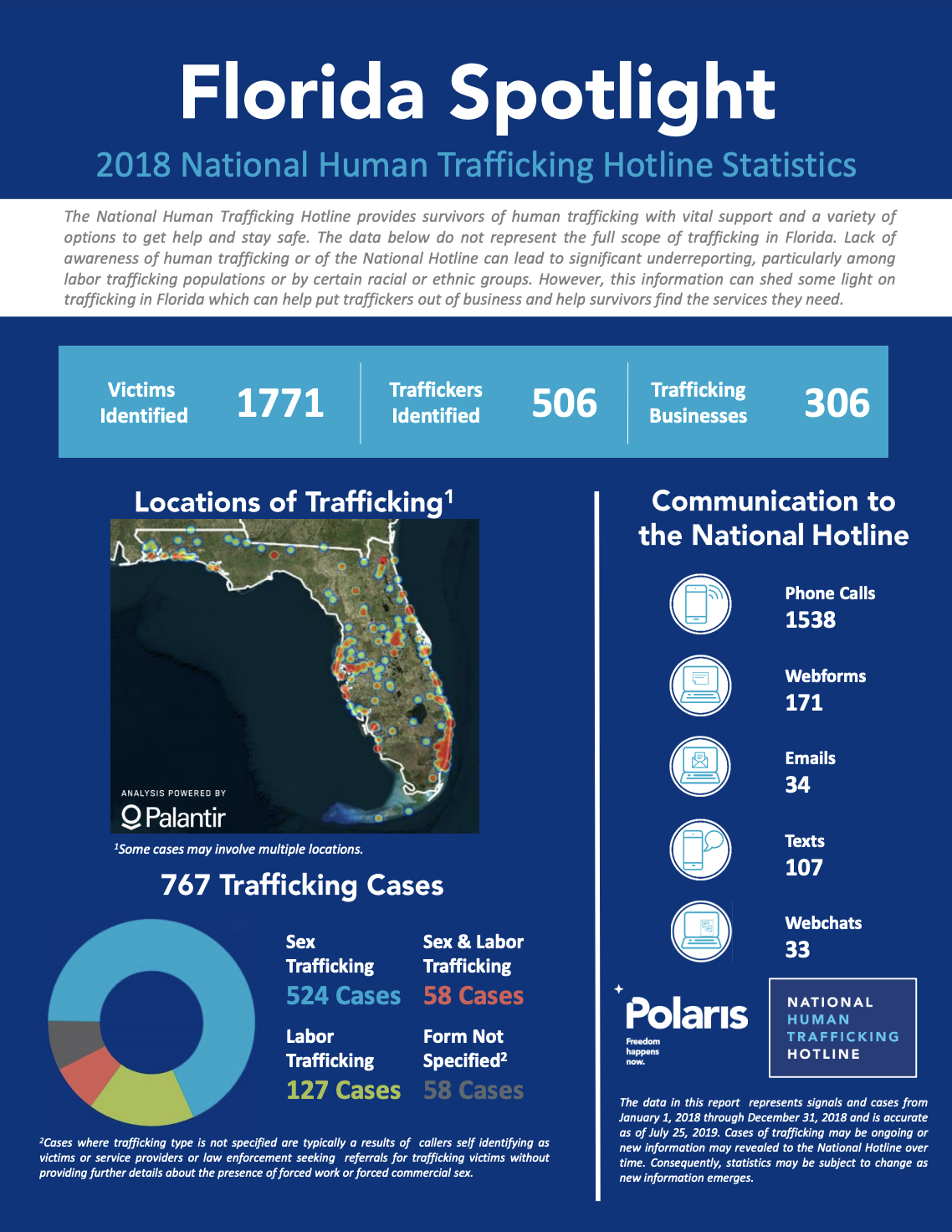
The data in this report represents signals and cases from January 1, 2018 through December 31, 2018 and is accurate as of July 25, 2019. Cases of trafficking may be ongoing or new information may revealed to the National Hotline over time. Consequently, statistics may be subject to change as new information emerges.

You can download the report infographic below.

National Hotline 2018 Florida State Report - National Human Trafficking Hotline, 2019 DOWNLOAD

post

page

attachment

revision

nav_menu_item

custom_css

customize_changeset

oembed_cache

user_request

wp_block

wp_template

wp_template_part

wp_global_styles

wp_navigation

wp_font_family

wp_font_face

acf-taxonomy

acf-post-type

acf-field-group

acf-field

ai1ec_event

exactmetrics_note

Moving from paper to practice: ASX200 reporting under Australia’s Modern Slavery Act
Publications

The research finds that most companies complied with the minimum requirements of modern slavery reporting, with clear groups of leaders and laggards within the ASX200. Perhaps unsurprisingly, given this is the first year of reporting, the majority o...Read More

Recognising Lived Realities
Publications

This briefing presents the findings of a project, led by University of Liverpool in partnership with FLEX and funded by the British Academy with the Department for International Development. The project assessed how transparency in supply chain...Read More

Are child domestic workers worse off than their peers? Comparing children in domestic work, child marriage, and kinship care with biological children of household heads: Evidence from Zimbabwe
Publications

Child domestic work is a hidden form of child labour driven by poverty and social norms. However, little is known about the situations of child domestic workers. This study aims to describe and analyse gender-specific working conditions, health, and...Read More

Regional study on defining recruitment fees and related costs: The Americas
Publications

This regional, comparative study aims to summarize the situation in the Americas, by identifying regional and national policies and legislation on defining recruitment fees and related costs and regulation of Public Employment Services (PES) and Pri...Read More