
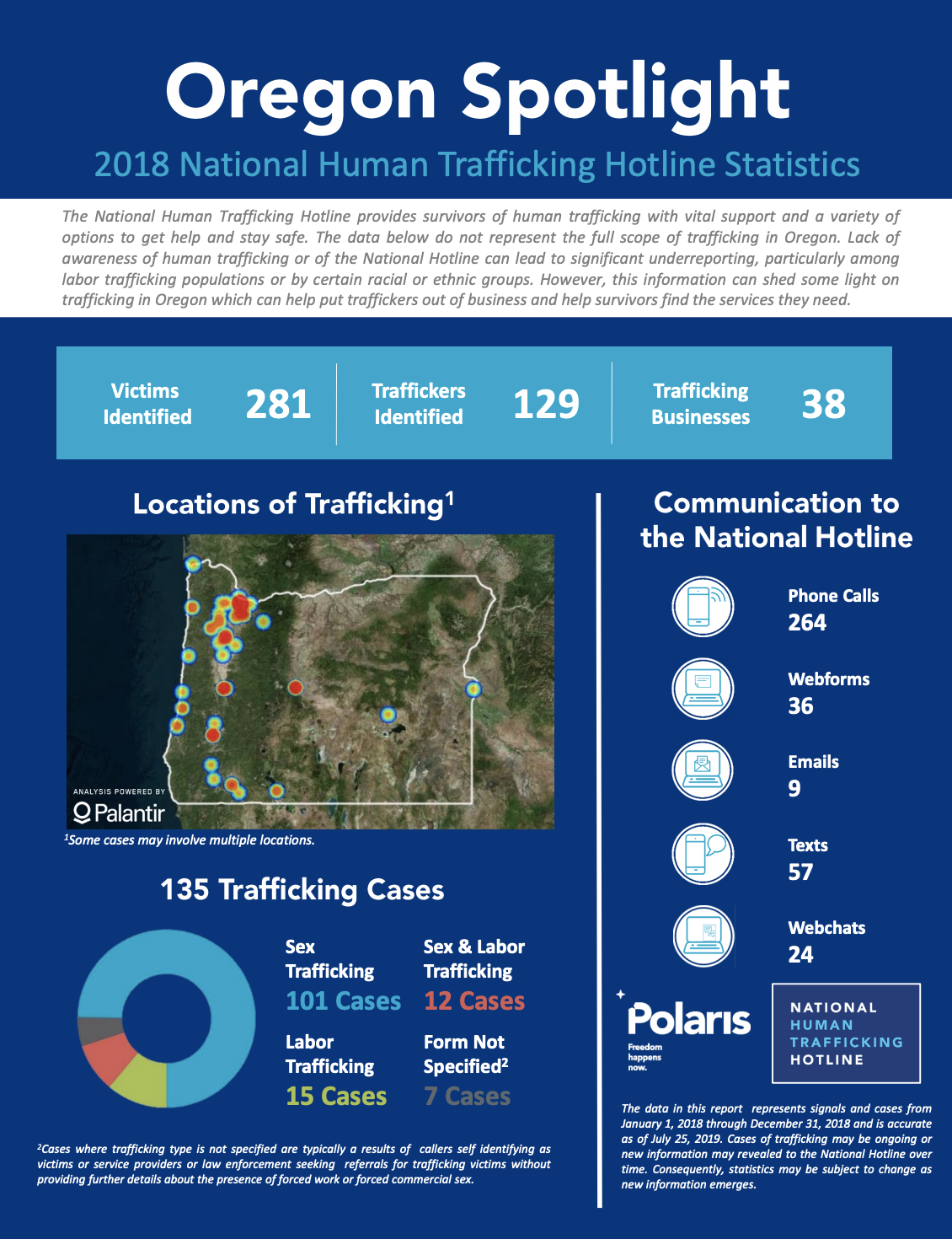
The data in this report represents signals and cases from January 1, 2018 through December 31, 2018 and is accurate as of July 25, 2019. Cases of trafficking may be ongoing or new information may revealed to the National Hotline over time. Consequently, statistics may be subject to change as new information emerges.

You can download the report infographic below.

National Hotline 2018 Oregon State Report - National Human Trafficking Hotline, 2019 DOWNLOAD

post

page

attachment

revision

nav_menu_item

custom_css

customize_changeset

oembed_cache

user_request

wp_block

wp_template

wp_template_part

wp_global_styles

wp_navigation

wp_font_family

wp_font_face

acf-taxonomy

acf-post-type

acf-field-group

acf-field

ai1ec_event

exactmetrics_note

Exploring Intersections of Trafficking in Persons Vulnerability and Environmental Degradation in Forestry and Adjacent Sectors– Mozambique Case Study
Publications

This report summarises case study research carried out in Mozambique in two sectors linked to deforestation: illicit logging of Pterocarpus Tinctorius in Tete Province and construction of the Cuamba–Mandimba–Lichinga section of the N13 road (par...Read More

The Impact of COVID-19 on Modern Slavery and Human Trafficking
COVID-19 resourcesPublications

This publication provides an overview of the epidemic of modern slavery and human trafficking, surveys some of ways that these challenges have been negatively transformed by COVID-19, and explores how approaches rooted in principles of computational...Read More

A Call to Action: Ending the Use of All Forms of Child Labour in Supply Chains
Publications

This report offers seven recommendations, such as developing incentives for businesses to thoroughly and continually monitor their supply chains for the use of child labour and forced labour, and to share best practices. It also recommends the Gover...Read More

Top 5 Labour abuses in 2019-2020- A field-based analysis of worker reporting and business responses In Thailand
COVID-19 resourcesGuidancePublications

Issara Institute recognizes worker voice as conveying the voices, experiences, and needs of workers, and channeling that voice into clear mechanisms committed to remediation and a rebalancing of power asymmetries between employers and workers. This ...Read More

TAGS: Asia