
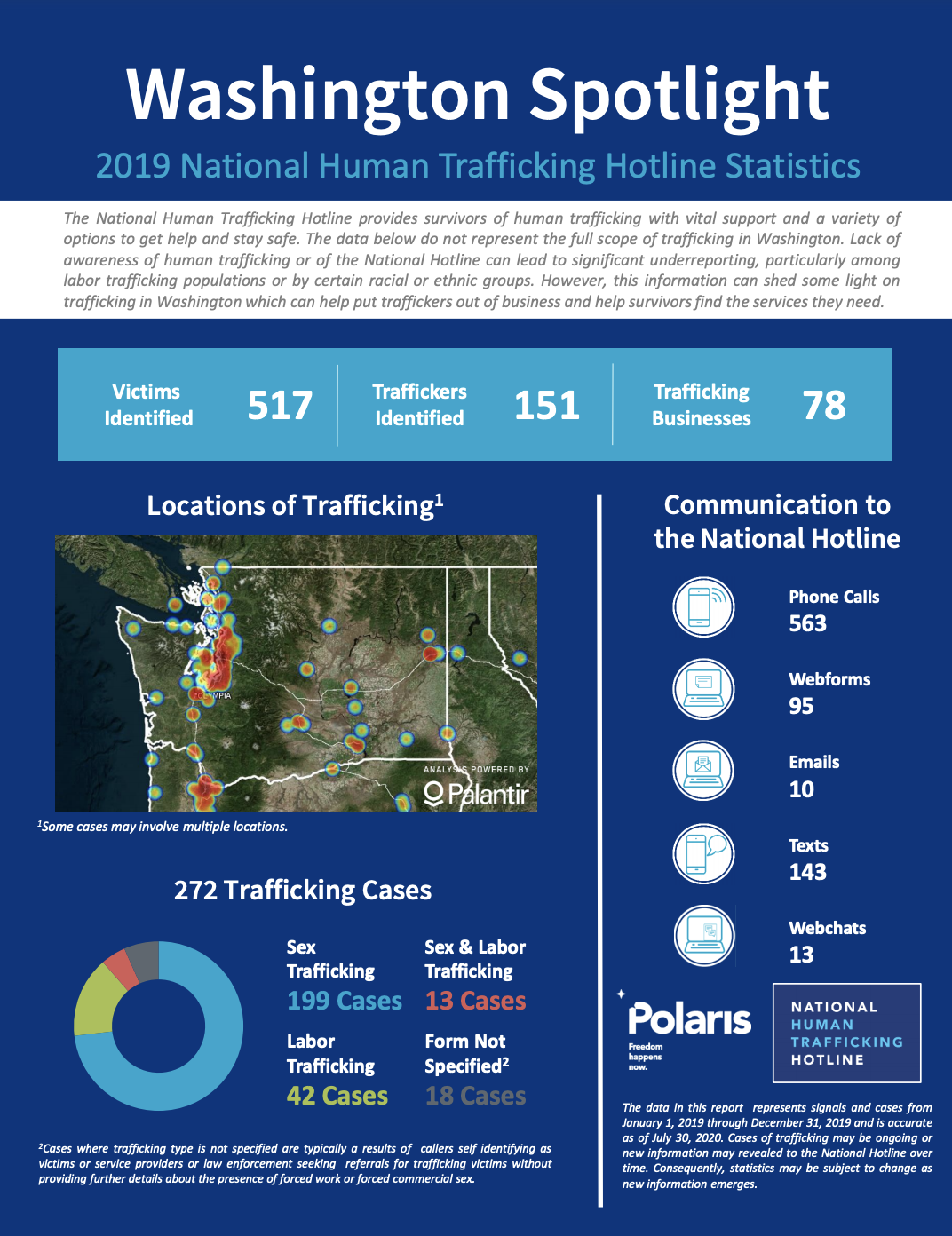
The data in this report represents signals and cases from January 1, 2019 through December 31, 2019 and is accurate as of July 30, 2020. Cases of trafficking may be ongoing or new information may revealed to the National Hotline over time. Consequently, statistics may be subject to change as new information emerges.

You can download the report infographic below.

National Hotline 2019 Washington State Report - National Human Trafficking Hotline, 2020 DOWNLOAD

post

page

attachment

revision

nav_menu_item

custom_css

customize_changeset

oembed_cache

user_request

wp_block

wp_template

wp_template_part

wp_global_styles

wp_navigation

wp_font_family

wp_font_face

acf-taxonomy

acf-post-type

acf-field-group

acf-field

ai1ec_event

exactmetrics_note

Investor Snapshot: Forced Labour in the Foresting Industry
Publications

It is estimated that 13 million workers are employed in the formal forestry sector while another 41 million workers are employed in the informal forestry sector. Much of this work takes place in remote areas where there is a lack of regulatory overs...Read More

Compendium of relevant reference materials and resources on ethical sourcing and prevention of trafficking in human beings for labour exploitation in supply chains
LegislationPublications

The objective of the Compendium of Resources is to take stock of the existing legislation, policies, guidelines, recommendations, reports, studies, and other types of initiatives developed to better understand and respond to the global problem of tra...Read More

Freedom First Celebrating 20 Years of Progress to Combat Human Trafficking
Publications

This retrospective report provides a historical perspective on the context in which the TVPA (the Trafficking Victims Protection Act of 2000) was crafted, celebrates the major accomplishments of the United States government, and provides a view of t...Read More

Labour on a Shoestring: The Realities of Working in Europe’s Shoe Manufacturing Peripheries in Albania, Bosnia-Herzegovina, Macedonia, Poland, Romania and Slovakia
Publications

Often consumers in Western Europe believe that “Made in Europe” is a synonym for working conditions that are better than in production countries in Asia. This report shows that this is not always the case, and that problematic working conditions...Read More

TAGS: Europe