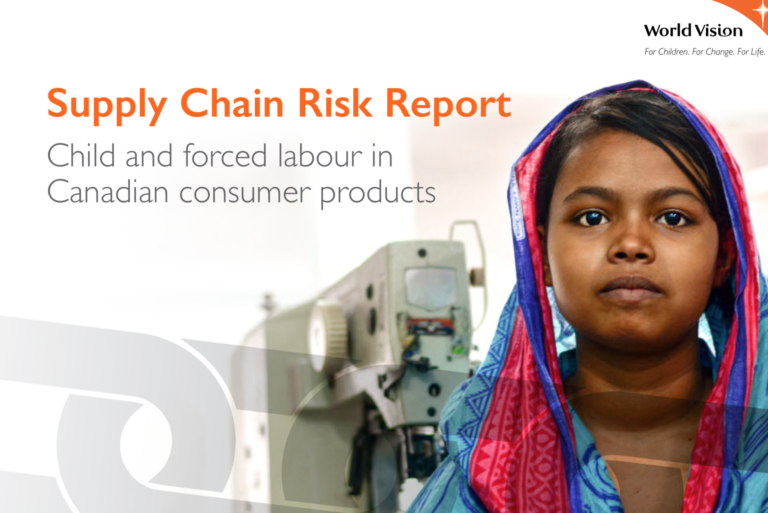
The report looks at Canada’s connection to the issues of human trafficking and forced and child labour, by cross-referencing recent data on Canadian imports with the U.S. Department of Labour’s List of Goods Produced by Child Labour or Forced Labuor. It tracks the supply chains of large Canadian companies and industries to identify potential links to the “risky products” that may be reaching stores in Canada.

As part of the research, authors tried to answer to several fundamental questions:
• What are Canadian companies doing to reduce the chances that children are toiling in
fields, factories, and fishing boats to produce their goods?
• How do companies know their efforts to prevent child and forced labour are working?
• What happens when they uncover problems in their supply chains?
• How are they sharing this information with consumers and investors?

Supply Chain Risk Report: Child and forced labour in Canadian consumer products - World Vision Canada, 2016 DOWNLOAD

post

page

attachment

revision

nav_menu_item

custom_css

customize_changeset

oembed_cache

user_request

wp_block

wp_template

wp_template_part

wp_global_styles

wp_navigation

wp_font_family

wp_font_face

acf-taxonomy

acf-post-type

acf-field-group

acf-field

ai1ec_event

exactmetrics_note

THE CONCEPT OF ‘EXPLOITATION’ IN THE TRAFFICKING IN PERSONS PROTOCOL
Publications

Article 3(a) of the United Nations Protocol to Prevent, Suppress and Punish Trafficking in Persons, Especially Women and Children, supplementing the United Nations Convention against Transnational Organized Crime (Trafficking in Persons Protocol) de...Read More

TAGS:
Contemporary Forms of Slavery Affecting Persons Belonging to Ethnic, Religious and Linguistic Minority Communities – Report of the Special Rapporteur on Contemporary Forms of Slavery, Including Its Causes and Consequences, Tomoya Obokata
Publications

The present report of the Special Rapporteur on contemporary forms of slavery, including its causes and consequences, Tomoya Obokata, is submitted pursuant to Human Rights Council resolution 42/10. The report is focused on contemporary forms of ...Read More

TAGS: Global
Point of No Returns Part II – Human Rights: An assessment of asset managers’ approaches to human and labour rights
Publications

The number of modern slavery victims in global supply chains today is believed to stand at around 16 million, roughly the same number of enslaved people as during the transatlantic slave trade in the 18th century. While this statistic alone is sugge...Read More

Ministerial Declaration on Combating All Forms of Human Trafficking
Publications

The declaration encourage OSCE participating States to work with the business sector to apply principles of due diligence and transparency in assessing and addressing risks of exploitation throughout supply chains and ensuring that workers have acces...Read More