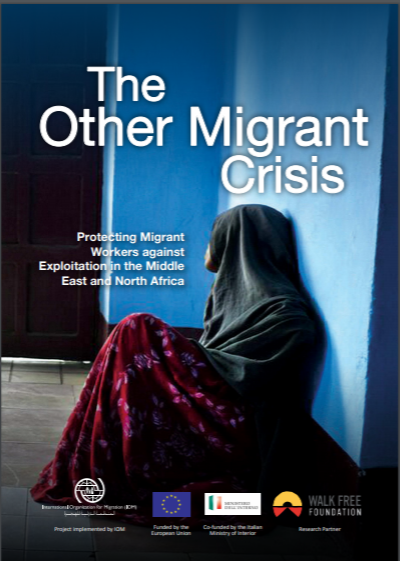
The Middle East and North Africa (MENA) region continues to host groups highly vulnerable to trafficking and exploitation. Migrant workers, particularly domestic workers, are known to be among those who are most at risk.

While the region is confronted by many pressing challenges – the rise of Islamic extremism, sectarian conflict and unrelenting hardships –
the massive numbers of displaced people and refugees on the move throughout MENA contribute to the extended profile of those vulnerable to trafficking and exploitation.

All of these conditions together, coupled with already exceedingly precarious working conditions for millions of migrant workers described in this report, create the conditions that are described as the “perfect storm” for human trafficking. This combination of factors is precisely the reason why it is so necessary to address human trafficking and migrant protection now.

The Other Migrant Crisis - Protecting Migrant Workers against Exploitation in the Middle East and North Africa - International Organization for Migration (IOM), 2015 DOWNLOAD

post

page

attachment

revision

nav_menu_item

custom_css

customize_changeset

oembed_cache

user_request

wp_block

wp_template

wp_template_part

wp_global_styles

wp_navigation

wp_font_family

wp_font_face

acf-taxonomy

acf-post-type

acf-field-group

acf-field

ai1ec_event

exactmetrics_note

An Alternative Anti-Trafficking Action Plan: A Proposed Model Based on a Labor Approach to Trafficking
Publications

TraffLab’s Alternative Anti-Trafficking Action Plan (the “Alternative Plan”) provides a labor-based alternative approach to the new Israeli national plan to address human trafficking 2019-2024, published by the Ministry of Justice in January 2...Read More

Supermarket Responsibilities for Supply Chain Workers’ Rights – Continuing Challenges in Seafood Supply Chains and the Case for Stronger Supermarket Action
Publications

International food supply chains provide employment for tens of millions of women and men around the world, demonstrating the potential for private sector actors to fight poverty and inequality. Yet far too many work in appalling conditions. The o...Read More

Child labour book series: Corporate social responsibility for farmers, No. 1: Understanding the concept of child labour
Publications

This booklet is one in a set of three booklets that aims at educating stakeholders about the problem of child labour, the national policies, legislation and strategies and the specific hazards of engagement of children in tobacco farming. Readers ...Read More

DISRUPTED CHILDHOOD – The Cost of Persuasive Design
Publications

Significant technological advances are very often accompanied by concerned debate. Will our daily lives be improved or disrupted? Will the need for human intervention or interaction be reduced? Will our relationships change? Digital technologies, un...Read More

TAGS: