
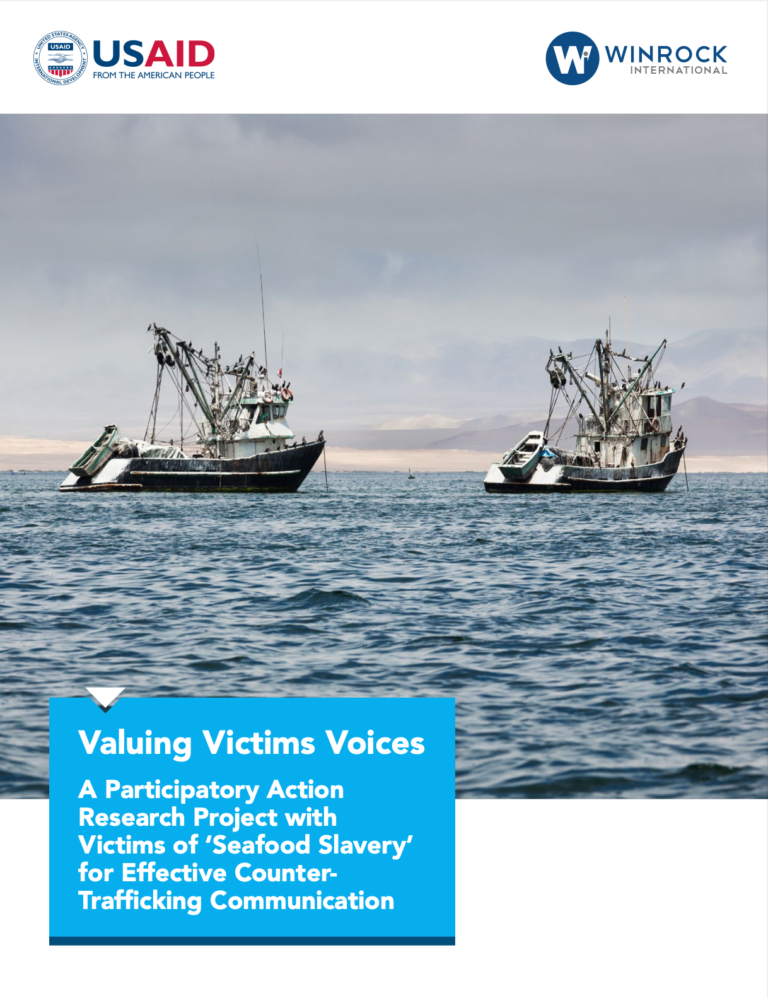
The exploitation of men working as fishing crew in distant water (DW) fisheries is attracting increasing attention from the international community as an urgent contemporary human and labour rights problem. However, the voices of victims are often drawn on in a highly selective and limited manner. We propose an alternative ap- proach and methodology to include victims in ways that aim to help address these problems. The project has three aims:
– to provide a platform through which victims of labour exploitation in the DW fisheries sector can articulate their experiences, concerns and problems according to their priorities and frames of reference.
– to build the capacity of (local) NGOs to undertake ethical and reflexive research to enhance the organisation’s work in supporting victims.
– to advance knowledge and understanding of labour exploitation and precarious work in the DW fisheries sector through a wider consideration of issues faced by victims.
Valuing Victims' Voices: A Participatory Action Research Project with Victims of "Seafood Slavery" for Effective Counter-Trafficking Communication - USAID and Winrock International, 2022 DOWNLOAD

post

page

attachment

revision

nav_menu_item

custom_css

customize_changeset

oembed_cache

user_request

wp_block

wp_template

wp_template_part

wp_global_styles

wp_navigation

wp_font_family

wp_font_face

acf-taxonomy

acf-post-type

acf-field-group

acf-field

ai1ec_event

exactmetrics_note

Freedom of movement for persons identified as victims of human trafficking: An analysis of law, policy and practice in the ASEAN Region
GuidancePublications

Author: Marika McAdam Sheltering victims of trafficking require a complex balance to be achieved between the rights of victims (including to freedom of movement and liberty), and the sometimes competing interests of other stakeholders. This Study...Read More

Sex work & racism
Guidance

Racialised people constitute an important yet frequently overlooked group of sex workers in Europe. The daily racism they experience is a result of European and North American chattel slavery, colonialism, and militarised prostitution. Under these s...Read More

From Local to Global: Building a strategic litigation ecosystem to address modern slavery in supply chains
Guidance

This briefing summarises the outcomes of the scopingresearch conducted by The Remedy Project, offeringan insight into the existing corporate accountabilitylegal landscape in South East Asia, and the barrierspreventing local groups from engaging in t...Read More

Modern Slavery Bill: Strengthening Transparency in Supply Chains (TISC)
News & AnalysisGuidance

The forthcoming Modern Slavery Bill, announced in the 2022 Queen’s Speech, presents a significant opportunity for the UK Government to implement its outstanding commitments in relation to strengthening Transparency in Supply Chains (TISC) provisio...Read More

TAGS: Europe