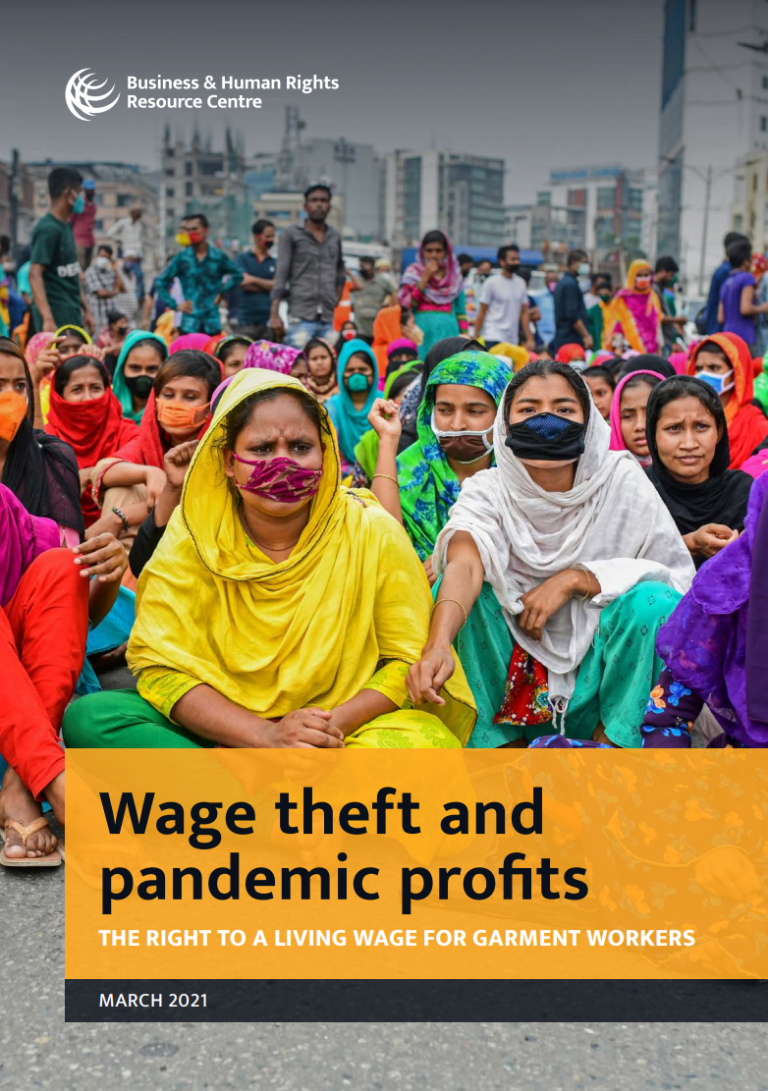
As stores closed around the world in response to COVID-19 lockdowns in early 2020, fashion brands and retailers sought to minimize their losses, shifting the financial burden of the disruption to the bottom of their supply chain. Cancelled orders, delayed payments and demands for huge ‘discounts’ from suppliers – the practice of paying only a fraction of the agreed amount for clothes ordered – had a catastrophic impact on workers. In response, BHRRC launched its COVID-19 apparel tracker, which monitors brands’ responses to the pandemic and the impact on workers in their supply chains. Since publishing the tracker in May 2020, international pressure through the Pay Up campaign, has led some brands, like Gap and Primark, to change their position and commit to paying for completed and in-production orders in full. Others, such as Walmart and Arcadia Group (Topshop), refuse to budge and pay what they owe. Recent research has found major fashion brands refused to pay overseas suppliers for over US $16 billion of goods during the pandemic between April and June 2020.

Wage Theft and Pandemic Profits: The Right to a Living Wage for Garment Workers - Business and Human Rights Resource Centre, 2021 DOWNLOAD

post

page

attachment

revision

nav_menu_item

custom_css

customize_changeset

oembed_cache

user_request

wp_block

wp_template

wp_template_part

wp_global_styles

wp_navigation

wp_font_family

wp_font_face

acf-taxonomy

acf-post-type

acf-field-group

acf-field

ai1ec_event

exactmetrics_note

National Hotline 2018 Massachusetts State Report
Graphics & InfographicsPublications

The data in this report represents signals and cases from January 1, 2018 through December 31, 2018 and is accurate as of July 25, 2019. Cases of trafficking may be ongoing or new information may revealed to the National Hotline over time. Consequen...Read More

Impact of the CARE Tipping Point Program in Nepal on adolescent girls’ agency and risk of child, early, or forced marriage: Results from a cluster-randomized controlled trial
Publications

ackground: Girl child, early, and forced marriage (CEFM) persists in South Asia, with long-term effects on well- being. CARE’s Tipping Point Initiative (TPI) sought to address the gender norms and inequalities underlying CEFM by engaging part...Read More

TAGS:
Pervasive, punitive, and predetermined: Understanding modern slavery in North Korea
Publications

By Remco E. Breuker & Imke van Gardingen It has long been known, though difficult to verify, that citizens of North Korea are forced to work by the State on a far greater scale than seen elsewhere in the world. Recent estimates reveal that 1 in ...Read More

TAGS: Asia
Human Trafficking & Modern Slavery – 2018 Report
Publications

In September 2017, The Evening Standard and The Independent, in partnership with the Independent Anti-Slavery Commissioner, launched a three-month special investigation into the issue of modern slavery. The special investigation, which was personally...Read More

TAGS: Europe