
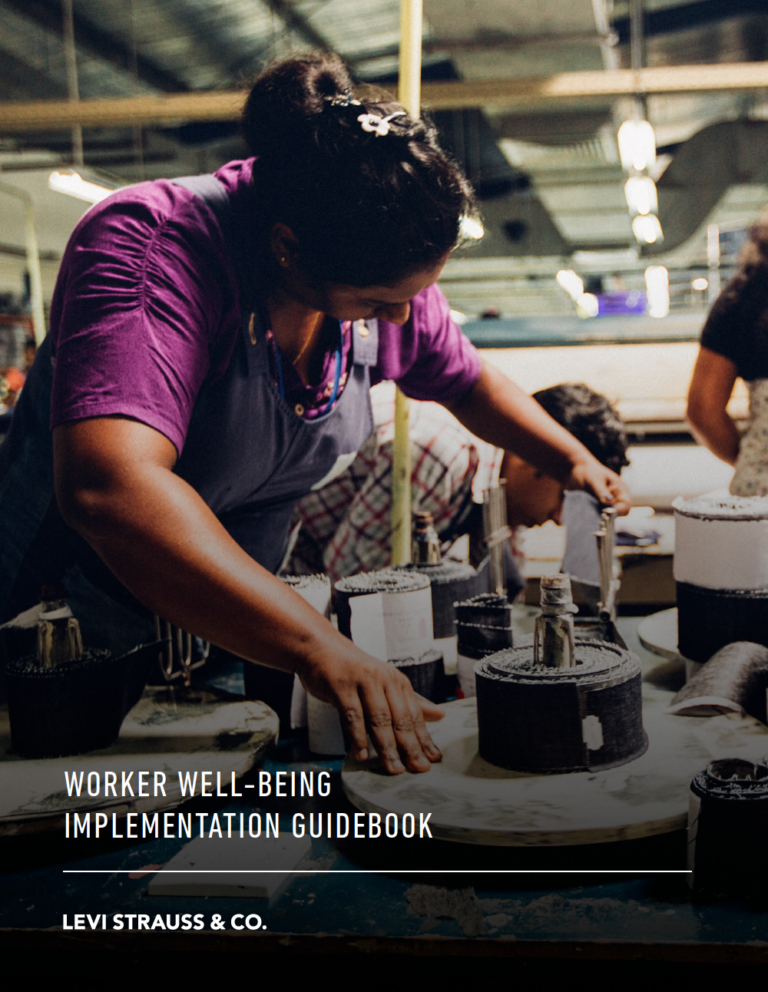
This Guidebook presents information on the Levi Strauss & Co. (LS&Co.) Worker Well-being (WWB), a supply chain initiative introduced by LS&Co. to raise the living standards of workers through partnerships with strategic vendors. The Guidebook outlines the criteria for vendor selection into WWB, implementation standards and requirements for validation of vendor programs. The guidelines in this document are applicable to all LS&Co. vendors and we expect that, with time, all supply chain partners meet these criteria.

Worker Well-Being Implementation Guidebook - Levi Strauss & Co., 2016 DOWNLOAD

post

page

attachment

revision

nav_menu_item

custom_css

customize_changeset

oembed_cache

user_request

wp_block

wp_template

wp_template_part

wp_global_styles

wp_navigation

wp_font_family

wp_font_face

acf-taxonomy

acf-post-type

acf-field-group

acf-field

ai1ec_event

exactmetrics_note

Guidelines on Respecting Human Rights in Responsible Supply Chains
Guidance

While globalization has driven economic development, the world faces difficult issues such as widening disparities and poverty, the escalation of climate change and other environmental problems, the spread of infectious diseases, and the eruption of...Read More

Delta 8.7 justice policy guide
Guidance

Justice, in its broadest sense, is the foundation on which efforts to tackle modern slavery internationally, nationally and locally rest. For Target 8.7 of the United Nations Sustainable Development Goals (SDGs) to be fully realized, it is clear tha...Read More

The Deaths of Migrants in the Gulf
Guidance

The economies of the six oil-rich Gulf states of Bahrain, Kuwait, Oman, Qatar, Saudi Arabia and the United Arab Emirates (UAE) are highly dependent on low-paid migrant workers from Asian states such as India, Nepal, Pakistan, Bangladesh, Sri Lan...Read More

Migrant Workers at Risk: Trends in Gulf Construction 2018−2019
Guidance

An overview of the risks to migrant workers on construction projects across the Gulf. Migrant workers make up between 60% and 90% of the workforce in the six countries of the Gulf Cooperation Council (GCC). Low-wage construction workers are at parti...Read More