
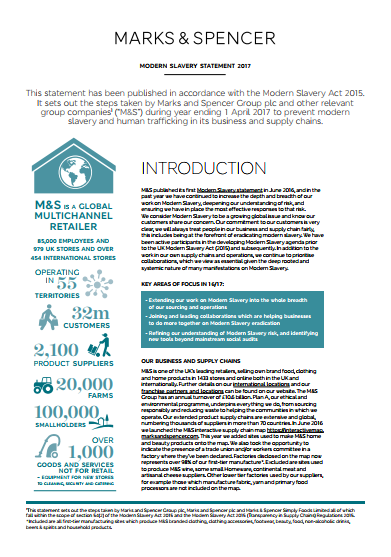
This statement has been published in accordance with the Modern Slavery Act 2015. It sets out the steps taken by Marks and Spencer Group plc and other relevant group companies (“M&S”) during year ending 1 April 2017 to prevent modern slavery and human trafficking in its business and supply chains.

Marks & Spencer Modern Slavery Statement 2017 DOWNLOAD

post

page

attachment

revision

nav_menu_item

custom_css

customize_changeset

oembed_cache

user_request

wp_block

wp_template

wp_template_part

wp_global_styles

wp_navigation

wp_font_family

wp_font_face

acf-taxonomy

acf-post-type

acf-field-group

acf-field

ai1ec_event

exactmetrics_note

Responsible Business Alliance Code of Conduct
Standards & Codes of Conduct

The Responsible Business Alliance (RBA) Code of Conduct is a set of social, environmental and ethical industry standards. The standards set out in the Code of Conduct reference international norms and standards including the Universal Declarati...Read More

TAGS: Global
Guidelines for Employment and Integration of People Displaced from Ukraine
GuidanceStandards & Codes of ConductGood Practices

To reduce the risk to workers displaced due to the war in Ukraine, ETI established a working group with its members shortly after the Russian invasion, in early Spring 2022. The aim of the working group has been to facilitate knowledge and intel...Read More

TAGS: Europe
Inditex Group Modern Slavery, Human Trafficking and Transparency in Supply Chain Statement FY2019
Standards & Codes of Conduct

This Statement, made pursuant to Section 54 of the UK Modern Slavery Act 2015 (taking into account the Guidance issued by the UK Government on 20 April 2020 on modern slavery reporting during the COVID-19 pandemic), Section 14 of the Australia Moder...Read More

Global Justice: Using Strategic Litigation to Combat Forced Labour
News & AnalysisStandards & Codes of ConductLegislation

Forced labor is a feature, not a bug, in today’s global economic system. Forced labor spans the globe. It involves multinational corporations. It is found in special economic zones—and war zones. And it is in everyone’s backyard. Globally, 27....Read More