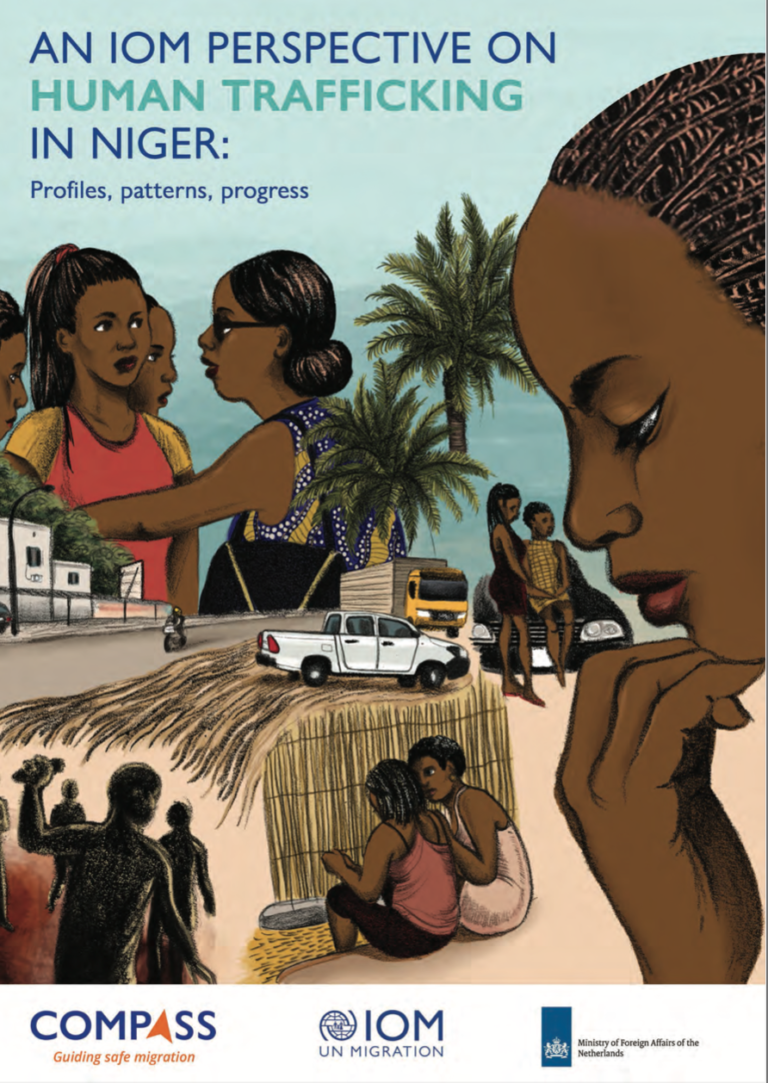
Often referred to as a country at the crossroads of migration flows between west, central and north Africa, Niger is at the heart of complex and multifold forms of mobility as a country of origin, transit and destination.

This includes trafficking in human beings. Victims of trafficking include adult migrants seeking jobs who have been lured into exploitative networks, or children who have been sent to look for economic opportunities within and across borders with trusted adults who have de facto become their traffickers.

This publication seeks to paint a picture of the phenomenon of human trafficking in Niger, based on IOM’s experience working with the national authorities in their relentless fight against trafficking in persons and the smuggling of migrants and well as through direct assistance to victims of trafficking in the various transit centers and in the government-run shelter. Based on the data collected, we are able to present a profile of victims and an overview of the complex socio-economic and cultural roots of human trafficking, which can inform future interventions and contribute to strengthening counter-trafficking efforts in Niger.

An IOM perspective on human trafficking in Niger: Profiles, patterns, progress - The International Organization for Migration, June 2022 DOWNLOAD

post

page

attachment

revision

nav_menu_item

custom_css

customize_changeset

oembed_cache

user_request

wp_block

wp_template

wp_template_part

wp_global_styles

wp_navigation

wp_font_family

wp_font_face

acf-taxonomy

acf-post-type

acf-field-group

acf-field

ai1ec_event

exactmetrics_note

Malawi’s Human-Trafficking Routes: Mapping Cross-Boarder Transit Points Using Collective Data
News & AnalysisGuidance

The existence of our group, the Malawi Network Against Trafficking, is testament to the high level of collaboration and support that already exists within the anti-trafficking sphere in Malawi. We are very lucky to have a community that spans nearly...Read More

No limits to exploitation: Migrant labourers in the supply chains of German supermarkets
News & Analysis

Fat profits on the one hand, starvation wages on the other: The inequalities along the supply chains for our food are enormous. Dieter Schwarz, owner of Lidl and Kaufland, earns the annual income of a farmworker on a pineapple plantation in Costa Ri...Read More

Gender-based violence in the garment and textile sector
News & Analysis

This chapter documents the research carried out in the garment and textile sector. Individual and group interviews were carried out with 26 women trade union leaders and union representatives from unions in four garment producing countries: El Salva...Read More

A Brief Guide to Ethical Recruitment for the Palm Oil Sector
News & Analysis

According to recent reports, the global palm oil market is expected to reach USD 92.84 billion in 2021. Palm oil and palm-based ingredients are found inapproximately 50 percent of supermarket products making them ever present in our daily consumptio...Read More