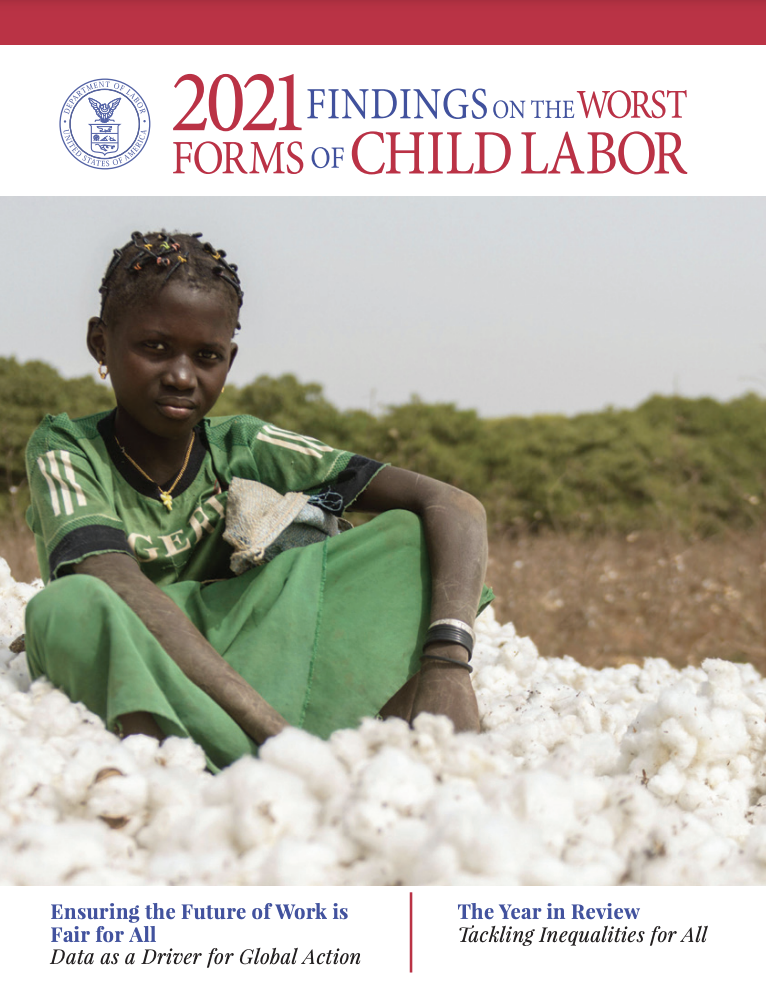
The U.S. Department of Labor has prepared the 2021 Findings on the Worst Forms of Child Labor in accordance with the Trade and Development Act of 2000 (TDA). (1) The TDA set forth the requirement that a country must implement its commitments to eliminate the worst forms of child labor for the President of the United States to designate the country a beneficiary developing country under the Generalized System of Preferences (GSP) program (subject to an exception if designation is in the national economic interest of the United States). (2; 3) The TDA also mandated that the President submit to the United States Congress the Secretary of Labor’s findings with respect to each “beneficiary country’s implementation of its international commitments to eliminate the worst forms of child labor.” (1) ILAB carries out this responsibility on behalf of the Secretary.

Country Coverage

This report covers 119 independent countries and 15 non-independent countries and territories designated as GSP beneficiaries. This includes former GSP recipients who have negotiated free-trade agreements with the United States. (4) Because the population of children is extremely small (fewer than 50) or non-existent in the British Indian Ocean Territory, Heard Island and McDonald Islands, and the Pitcairn Islands, the report does not contain a discussion of these three non-independent countries and territories. The 2021 report presents information on child labor and the worst forms of child labor, and efforts to eliminate this exploitation in the remaining 119 countries and 12 nonindependent countries and territories. The use of “countries” in this report includes territories, and because the report focuses on government efforts, non-independent countries and territories are classified by their associated regions.

2021 Findings on the Worst Forms of Child Labor - United States Department of Labor, 2022 DOWNLOAD

post

page

attachment

revision

nav_menu_item

custom_css

customize_changeset

oembed_cache

user_request

wp_block

wp_template

wp_template_part

wp_global_styles

wp_navigation

wp_font_family

wp_font_face

acf-taxonomy

acf-post-type

acf-field-group

acf-field

ai1ec_event

exactmetrics_note

The Counter-Trafficking Apparatus in Action: Who Benefits From It?
Publications

Based on long-term ethnographic research, including documentary research, qualitative interviews and observations made at a Portuguese shelter for “sex trafficked women,” this paper explores the counter-trafficking apparatus questioning who bene...Read More

TAGS: Europe
Seeds in our pockets – How can funders nurture thriving social justice movements by and for people on the move
Publications

In 2022 Porticus launched a pilot learning year to support the development of a new global programme, Transforming migration parameters through movement building and lived-experience leadership’ (hereafter MOVE) within the People on the Move Portf...Read More

TAGS:
Determinants of Anti-Trafficking Efforts: Case Study: Algeria
News & AnalysisPublications

This study was carried out to identify and sequence the determinants impacting the Algerian government’s anti-trafficking efforts. As the only study so far to explore the issue of determinants in Algeria, the authors anticipate this report will im...Read More

TAGS: Africa
A PATHWAY TO JUSTICE OR A ROAD TO NOWHERE? Trafficked migrants’ experience of seeking justice in Hong Kong
Publications

This report considers how effectively the Action Plan to Tackle Trafficking in Persons and to Enhance Protection of Foreign Domestic Helpers in Hong Kong (the Action Plan) 1 has been implemented and, specifically, whether it has helped trafficked pe...Read More

TAGS: