In the last five years, there has been growing attention and investments into prevalence estimates.

The increasing investment into prevalence estimates is much welcomed, but it has also led to fragmented efforts among researchers. People at The Freedom Fund have observed disparate groups of experts – often separated by geographies and subject areas – developing definitions, methodologies and tools in parallel and not always in accord with one another.

To help foster alignment, the Freedom Fund hosted this Technical Convening with three explicit objectives:

  1. To bring together leading researchers in the global modern slavery movement;
  2. To build consensus around promising methods; and
  3. To encourage cross-pollination of techniques and tools.

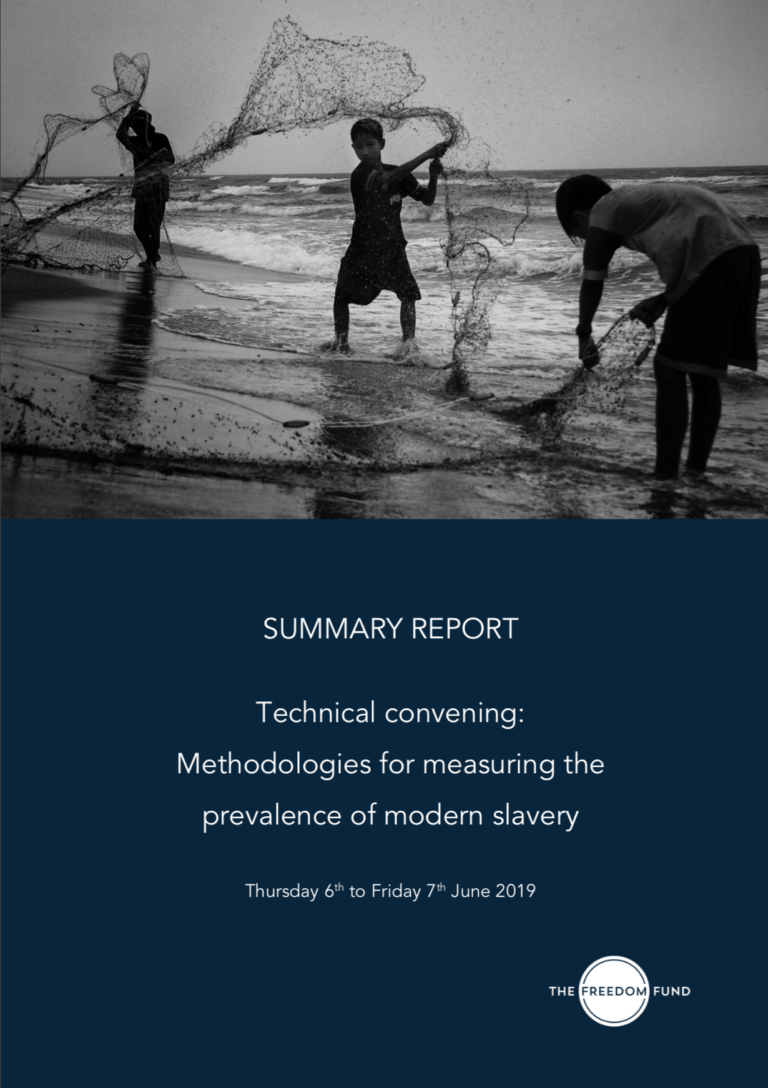
The Freedom Fund’s technical convening – titled ‘Methodologies for measuring the prevalence of modern slavery’ – took place in London on 6th to 7th June 2019. The event brought together leading researchers, government representatives and funders to discuss the methods and challenges of measuring child exploitation, forced labour, debt bondage, commercial sexual exploitation and forced marriage. Through a series of panel and group discussions, the convening sought to build consensus on future directions for the field, and to encourage cooperation, cross-pollination and sharing of expertise. This report summarises those discussions but does not necessarily represent the views of all participants.

Technical Convening: Methodologies for Measuring the Prevalence of Modern Slavery DOWNLOAD

post

page

attachment

revision

nav_menu_item

custom_css

customize_changeset

oembed_cache

user_request

wp_block

wp_template

wp_template_part

wp_global_styles

wp_navigation

wp_font_family

wp_font_face

acf-taxonomy

acf-post-type

acf-field-group

acf-field

ai1ec_event

exactmetrics_note

Hidden Chains: Rights Abuses and Forced Labour in Thailand’s Fishing Industry
Publications

The report by Human Rights Watch describes how migrant fishers from neighboring countries in Southeast Asia are often trafficked into fishing work, prevented from changing employers, not paid on time, and paid below the minimum wage. Migrant workers ...Read More

Contemporary Forms of Slavery Affecting Persons Belonging to Ethnic, Religious and Linguistic Minority Communities – Report of the Special Rapporteur on Contemporary Forms of Slavery, Including Its Causes and Consequences
Publications

The present report of the Special Rapporteur on contemporary forms of slavery, including its causes and consequences, Tomoya Obokata, is submitted pursuant to Human Rights Council resolution 42/10. The report is focused on contemporary forms of ...Read More

TAGS: Global
Food & Beverage Benchmark Findings Report
Publications

According to the International Labour Organization (ILO), an estimated 21 million people are victims of forced labor around the world. As defined by the ILO, forced labor refers to “situations in which persons are coerced to work through the use o...Read More

National Hotline 2016 – Northern Mariana Islands Report
Graphics & InfographicsPublications

The following information is based on incoming communication with the National Human Trafficking Hotline from January 1, 2016 – December 31, 2016 about human trafficking cases and issues related to human trafficking in the Northern Mariana Islands...Read More