
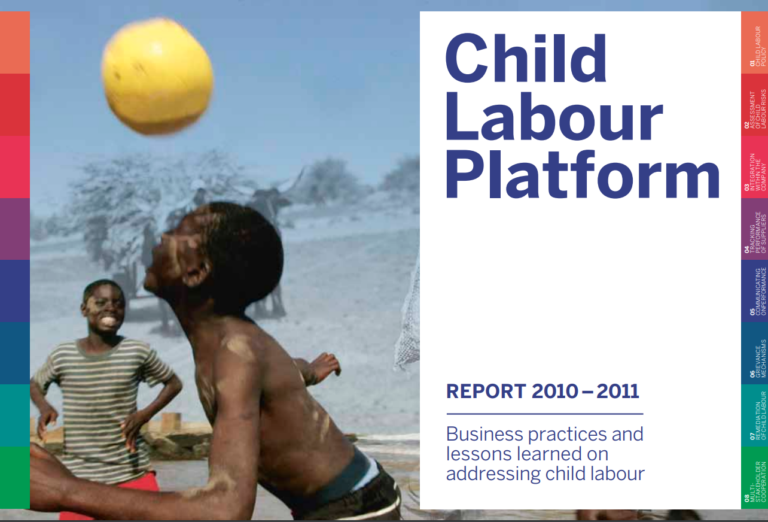
This booklet is meant as inspiration and provides practical information for managers and employees, who have responsibilities for addressing child labour within the company’s operations and supply chain. The booklet contains business practices and lessons learned building on the experiences of the companies participating in the Child Labour Platform during its first year. The discussions of the practices and lessons learned have been informed by the Guiding Principles on Business and Human Rights and its various components.

The practices described are from different sectors and different regions and therefore potentially applicable in many sectors and countries. They are neither static, nor exhaustive: as these practices and experiences may evolve, they could be refined and built on during future phases of the Child Labour Platform.

Child Labour Platform: Report 2010-2011, Business practices and lessons learned on addressing child labour, Child Labour Platform, the Sustainable Trade Initiative (IDH), 2012 DOWNLOAD

post

page

attachment

revision

nav_menu_item

custom_css

customize_changeset

oembed_cache

user_request

wp_block

wp_template

wp_template_part

wp_global_styles

wp_navigation

wp_font_family

wp_font_face

acf-taxonomy

acf-post-type

acf-field-group

acf-field

ai1ec_event

exactmetrics_note

A Review of Current Promising Practices in the Engagement of People with Lived Experience to Address Modern Slavery and Human Trafficking
News & AnalysisGuidanceGood Practices

This report summarises findings from research into the best ways to engage and involve people with lived experience of modern slavery and human trafficking (including survivors) in international policy and programming on modern slavery. It gathers o...Read More

TAGS: Global
Employing Workers’ Sense of Value as a Key Performance Indicator (KPI) to Drive Facility Improvement in Social Responsibility
Good Practices

While many brands have gathered worker feedback to increase engagement, when closely examined, the efforts have tended to be brand-centric with workers’ interests often overlooked or marginalized in favor of supply chain risk management. The findi...Read More

Human rights in supply chains: Promoting positive practice
Good Practices

This report provides a unique insight into the current drivers, practices, and challenges of Australian businesses in managing human rights in their supply chains. Importantly, the report provides practical guidance to assist business with identify...Read More

TAGS: Oceania
Using SAS® Text Analytics to Assess International Human Trafficking Patterns
Good PracticesPublications

By Tom Sabo, Adam Pilz, SAS Institute Inc. Abstract  The US Department of State (DOS) and other humanitarian agencies have a vested interest in assessing and preventing human trafficking in its many forms. A subdivision within the DOS releases pub...Read More