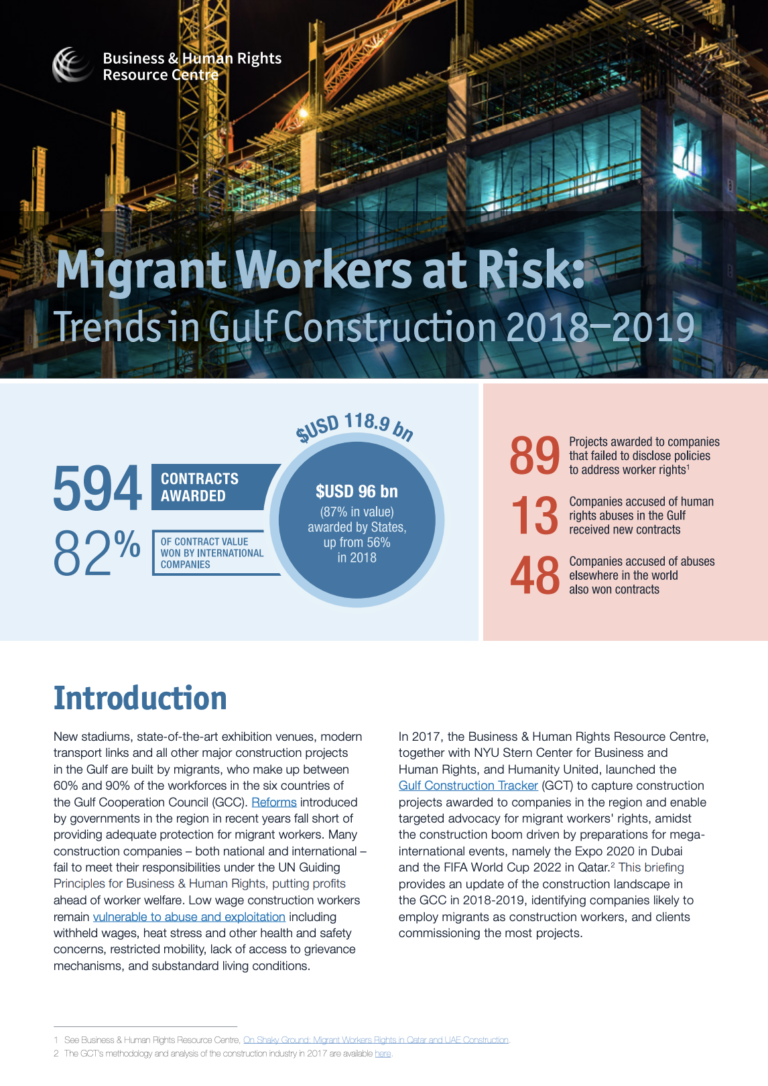
An overview of the risks to migrant workers on construction projects across the Gulf.

Migrant workers make up between 60% and 90% of the workforce in the six countries of the Gulf Cooperation Council (GCC). Low-wage construction workers are at particular risk from labour exploitation from their employers, and face abuses including withheld wages, heat stress and other health and safety concerns, restricted mobility, lack of access to grievance mechanisms and remedy, and substandard living conditions.

The briefing issues recommendations for clients and companies on adopting and enforcing robust human rights protections for migrant workers.

Migrant Workers at Risk: Trends in Gulf Construction 2018−2019 - Business & Human Rights Resource Centre, 2020 DOWNLOAD

post

page

attachment

revision

nav_menu_item

custom_css

customize_changeset

oembed_cache

user_request

wp_block

wp_template

wp_template_part

wp_global_styles

wp_navigation

wp_font_family

wp_font_face

acf-taxonomy

acf-post-type

acf-field-group

acf-field

ai1ec_event

exactmetrics_note

The American Dream Up for Sale: A Blueprint for Ending International Labor Recruitment Abuse
GuidanceGood Practices

This report documents findings about the level of recruitment abuse in the United States work visa system and gaps in worker protections. Each year, hundreds of thousands of people from around the world are recruited to work in the United States ...Read More

Assessing Modern Slavery Risks in the Vietnam-Taiwan Migration Corridor
Guidance

This briefing note presents key findings and insights from a study conducted by Responsible Business Alliance (RBA), in collaboration with Verité, Ulula, and the Fair Hiring Initiative, with Vietnamese migrant workers at four destination workplaces...Read More

What works: Lessons learned in survivor inclusion
Guidance

The participation of modern slavery survivors in program development, implementation, and evaluation is crucial to anti-slavery efforts. Working with survivor activists to shape programs based on their lived experience results in developing and...Read More

National Referral Mechanisms – Joining Efforts to Protect the Rights of Trafficked Persons: A Practical Handbook
GuidanceGood Practices

This handbook provides guidance on how to design and implement sustainable mechanisms and structures to combat human trafficking and support victims. It also provides guidance on how to monitor and build the capacity of such mechanisms and structure...Read More