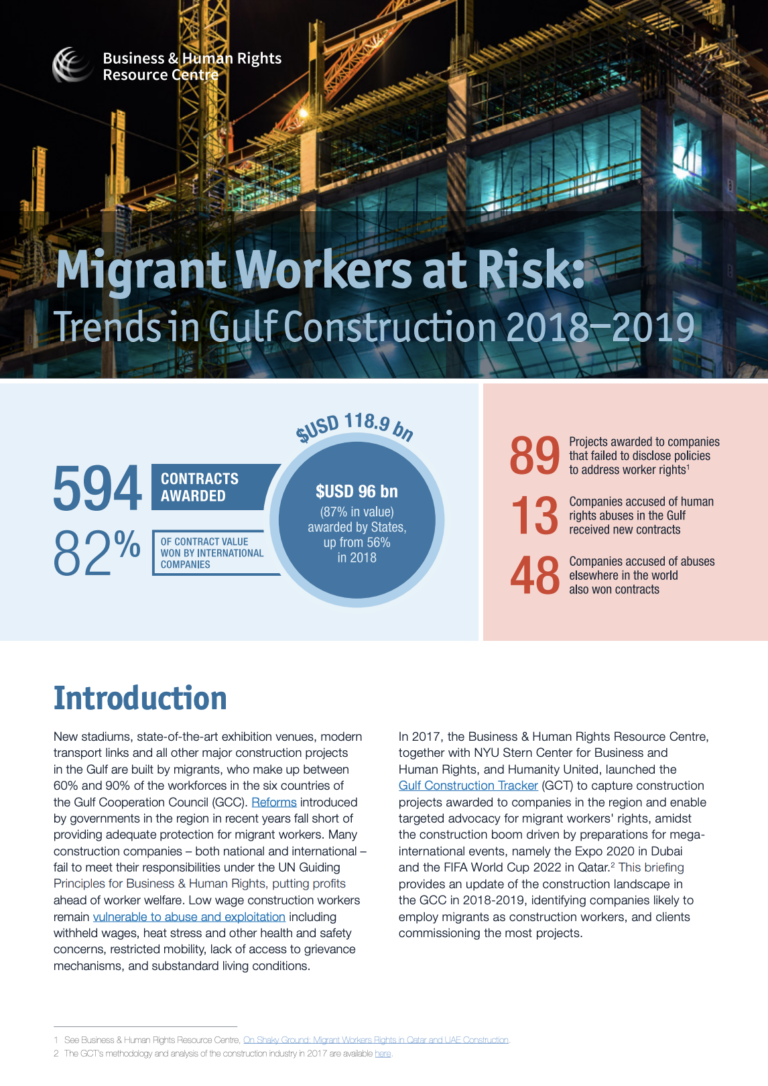
An overview of the risks to migrant workers on construction projects across the Gulf.

Migrant workers make up between 60% and 90% of the workforce in the six countries of the Gulf Cooperation Council (GCC). Low-wage construction workers are at particular risk from labour exploitation from their employers, and face abuses including withheld wages, heat stress and other health and safety concerns, restricted mobility, lack of access to grievance mechanisms and remedy, and substandard living conditions.

The briefing issues recommendations for clients and companies on adopting and enforcing robust human rights protections for migrant workers.

Migrant Workers at Risk: Trends in Gulf Construction 2018−2019 - Business & Human Rights Resource Centre, 2020 DOWNLOAD

post

page

attachment

revision

nav_menu_item

custom_css

customize_changeset

oembed_cache

user_request

wp_block

wp_template

wp_template_part

wp_global_styles

wp_navigation

wp_font_family

wp_font_face

acf-taxonomy

acf-post-type

acf-field-group

acf-field

ai1ec_event

exactmetrics_note

Still Overlooked: Communities affected by jade mining operations in Myanmar, and the responsibilities of companies providing machinery.
Guidance

Myanmar is a high-risk environment from a business and human rights perspective. Pockets of the country constitute some of the most complex environments in the world; one example is the mineral rich Kachin state in the northern part of the country, ...Read More

The role of social protection in the elimination of child labour: Evidence review and policy implications
Guidance

At the beginning of 2020 1 in 10 children aged 5 and over were involved in child labour worldwide – equating to an estimated 160 million children, or 63 million girls and 97 million boys. Despite significant progress in reducing child labour in th...Read More

Recommendations for Addressing Forced Labor Risk in the Cocoa Sector of Côte D’Ivoire
Guidance

Forced Labor — and human trafficking for forced labor — have been documented as recently as 2018 in the cocoa sector in Côte d’Ivoire, with one recent study by the Walk Free Foundation and Tulane University estimating the number of victims at...Read More

Disrupting Harm in Malaysia: Evidence on Online Child Sexual Exploitation and Abuse
Guidance

Funded by the Global Partnership to End Violence against Children, through its Safe Online initiative, ECPAT International, INTERPOL and UNICEF Office of Research – Innocenti worked in partnership to design and implement Disrupting Harm – a rese...Read More

TAGS: Asia