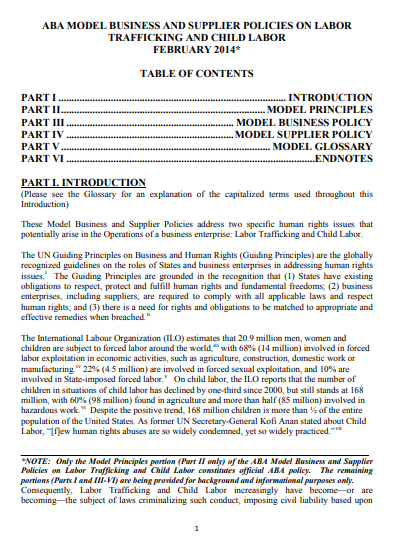
These Model Business and Supplier Policies address two specific human rights issues that potentially arise in the Operations of a business enterprise: Labour Trafficking and Child Labour.

The Model Policies adopt a risk-based approach to ensure that measures to address issues of Labour Trafficking and Child Labour are commensurate with the risks identified, so that the sources of the greatest risk receive the most attention, thereby facilitating efficient allocation of resources. The business enterprises that adopt and implement a form of these Model Policies should identify general areas where the risk of Labour Trafficking or Child Labour is more significant so they can prioritize those for greater Due Diligence, Monitoring, Verification or appropriate action under a given Model Policy.

ABA Model Business and Supplier Policies on Labour Trafficking and Child Labour - American Bar Association (ABA), 2014 DOWNLOAD

post

page

attachment

revision

nav_menu_item

custom_css

customize_changeset

oembed_cache

user_request

wp_block

wp_template

wp_template_part

wp_global_styles

wp_navigation

wp_font_family

wp_font_face

acf-taxonomy

acf-post-type

acf-field-group

acf-field

ai1ec_event

exactmetrics_note

A Policy Framework for Tackling the Economic and Social Impact of the COVID-19 crisis
COVID-19 resourcesStandards & Codes of Conduct

In June 2019, the International Labour Organization’s (ILO’s) 187 member States adopted the ILO Centenary Declaration for the Future of Work, calling on the Organization to pursue “with unrelenting vigour its constitutional mandate for social ...Read More

TAGS: Global
Sanofi Social Charter
Standards & Codes of Conduct

The Sanofi Social Charter reflects the values and attitudes of the company and the group, applies to all employees of the Group worldwide and reflects the commitment of Sanofi in terms of responsibility towards its employees and the environment. ...Read More

Corporate Human Rights Benchmark 2022: Insights Report
News & AnalysisGuidanceStandards & Codes of Conduct

The Corporate Human Rights Benchmark (CHRB) assessed three sectors in 2022: food and agricultural products (57 companies), ICT manufacturing (43 companies) and automotive manufacturing (29 companies). The revised CHRB methodology devotes more at...Read More

TAGS: Global
Addressing modern slavery in long and complex supply chains. Assessing understandings of effective supply chain governance
GuidanceStandards & Codes of Conduct

This is a summary of the report: Assessing understandings of effective supply chain governance , a Modern Slavery and Human Rights Policy and Evidence Centre (the Modern Slavery PEC) research project, funded by the UK Artsand Humanities Research Cou...Read More