
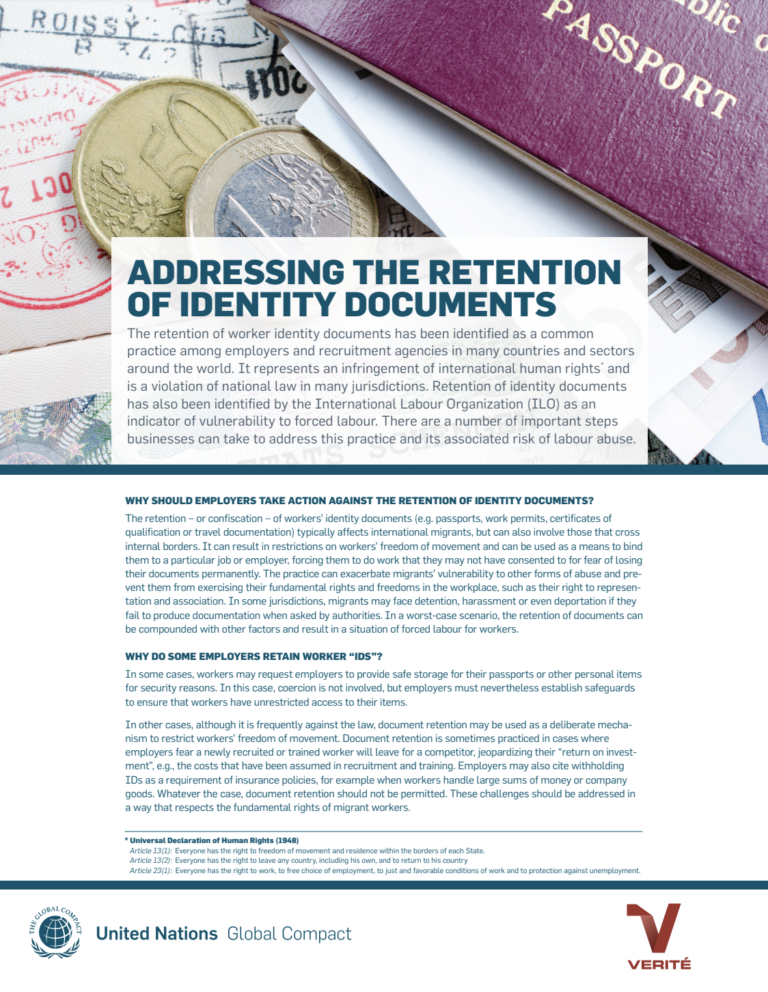
This document calls on businesses to prohibit worker document retention and gives best practice guidance.

Addressing the Retention of Identity Documents - United Nations Global Compact and Verité, 2014 DOWNLOAD

post

page

attachment

revision

nav_menu_item

custom_css

customize_changeset

oembed_cache

user_request

wp_block

wp_template

wp_template_part

wp_global_styles

wp_navigation

wp_font_family

wp_font_face

acf-taxonomy

acf-post-type

acf-field-group

acf-field

ai1ec_event

exactmetrics_note

The American Dream Up for Sale: A Blueprint for Ending International Labor Recruitment Abuse
GuidanceGood Practices

This report documents findings about the level of recruitment abuse in the United States work visa system and gaps in worker protections. Each year, hundreds of thousands of people from around the world are recruited to work in the United States ...Read More

Evidence from Japanese companies assessment on human rights due diligence
Guidance

The Human Rights Council unanimously endorsed the UN Guiding Principles on Business and Human Rights (UNGPs) in 2011. More than 10 years later, this global standard for how business should respect human rights has driven some positive change. While ...Read More

Eliminating Recruitment Fees Charged to Migrant Workers – United Nations Global Compact and Verite
GuidanceGood Practices

There are an estimated 232 million international migrants around the world today and over 90 percent of these are workers and their families. International labour migration is a defining feature of the global economy. Nearly every nation around the ...Read More

Combatting Human Trafficking since Palermo: What Do We Know about What Works?
Guidance

In 2016, there were an estimated 40.3 million victims of modern slavery in the world, more than were enslaved during the Transatlantic Slave Trade. Since the adoption of the 2000 UN Trafficking Protocol, numerous efforts from inter-governmental a...Read More

TAGS: Global