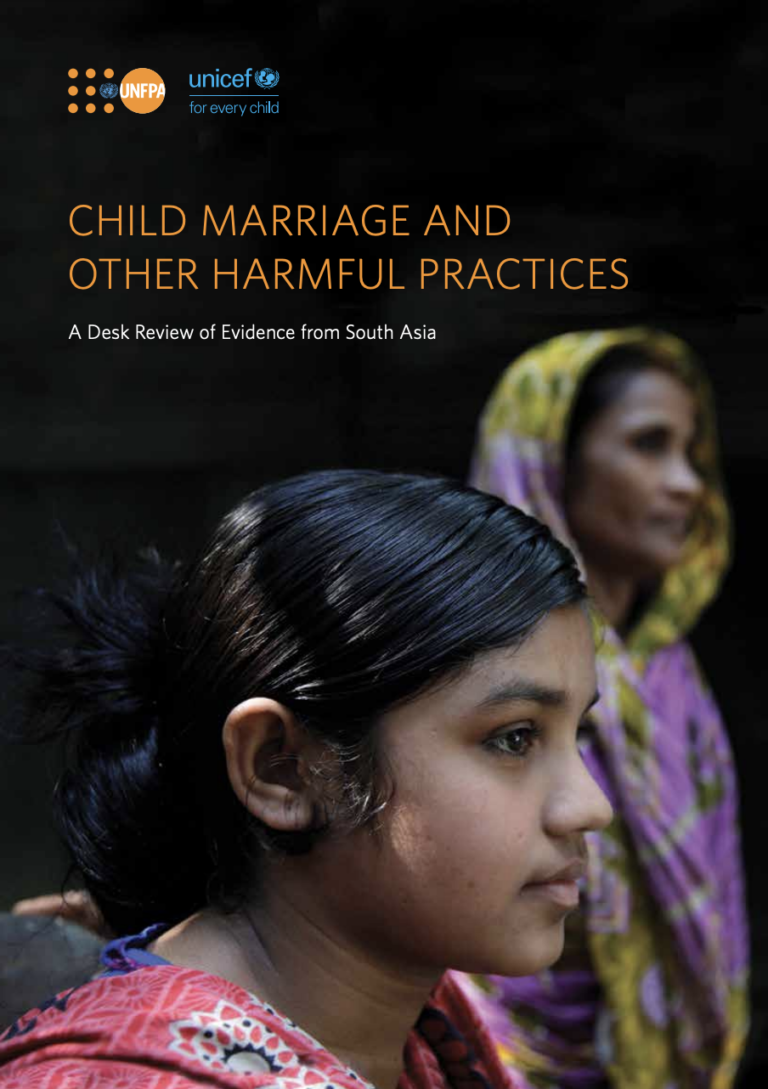
This study looks at the different forms that child marriage takes in South Asia and further looks at how these variations in child marriage practices are linked to other harmful practices. The study acknowledges that child marriage takes place in various forms and that these variations in child marriage practices are linked to other harmful practices. It describes the impact that programmes seeking to address child marriage may be having upon other harmful practices, such as polygamy, honour crimes and dowry-related violence, bride price and dowry, sex selection and female infanticide, menstruation practices, caste-based discrimination, and child labour. By identifying these linkages, programmes can be better informed about the potential impact of their interventions and can reflect on whether there are additional considerations that need to be taken into account.
Child Marriage and Other Harmful Practices - UNFPA and Unicef, 2020 DOWNLOAD

post

page

attachment

revision

nav_menu_item

custom_css

customize_changeset

oembed_cache

user_request

wp_block

wp_template

wp_template_part

wp_global_styles

wp_navigation

wp_font_family

wp_font_face

acf-taxonomy

acf-post-type

acf-field-group

acf-field

ai1ec_event

exactmetrics_note

The Case for an Australian Modern Slavery Act
Publications

Australia needs a “Modern Slavery Act” that addresses three issues as a priority: Anti-Slavery Commissioner - appointment of an Anti-Slavery Commissioner to provide independent oversight, with powers to monitor laws and hold business and th...Read More

TAGS: Oceania
Rapid assessment of children in child labour in Honiara, Solomon Islands
Publications

The Rapid Assessment of Children in Child Labour in Honiara, Solomon Islands, was commissioned by the International Labour Organization (ILO) in response to concerns raised at the first National Child Labour and Trafficking Forum in Honiara in Augu...Read More

Twenty Years After the Passage of the Palermo Protocol: Identifying Common Flaws in Defining Trafficking through the First Global Study of Domestic Anti-Trafficking Laws
Publications

On November 15, 2000, the United Nations adopted the Protocol to Prevent, Suppress and Punish Trafficking in Persons, Especially Women and Children (Palermo Protocol). Twenty years later, with 178 state parties, the Palermo Protocol has reached almo...Read More

TAGS: Global
Beyond Awareness: Learning from Local Experiences to Move Forward in Fighting Human Trafficking, A Regional Study on Local Perceptions of Human Trafficking In South And Southeast Asia
Publications

This report presents findings from a multiple case study of how human trafficking is perceived and experienced in seven local communities in five countries in South and South-East Asia. The aim of the report is to explore and understand local ex...Read More

TAGS: Asia