
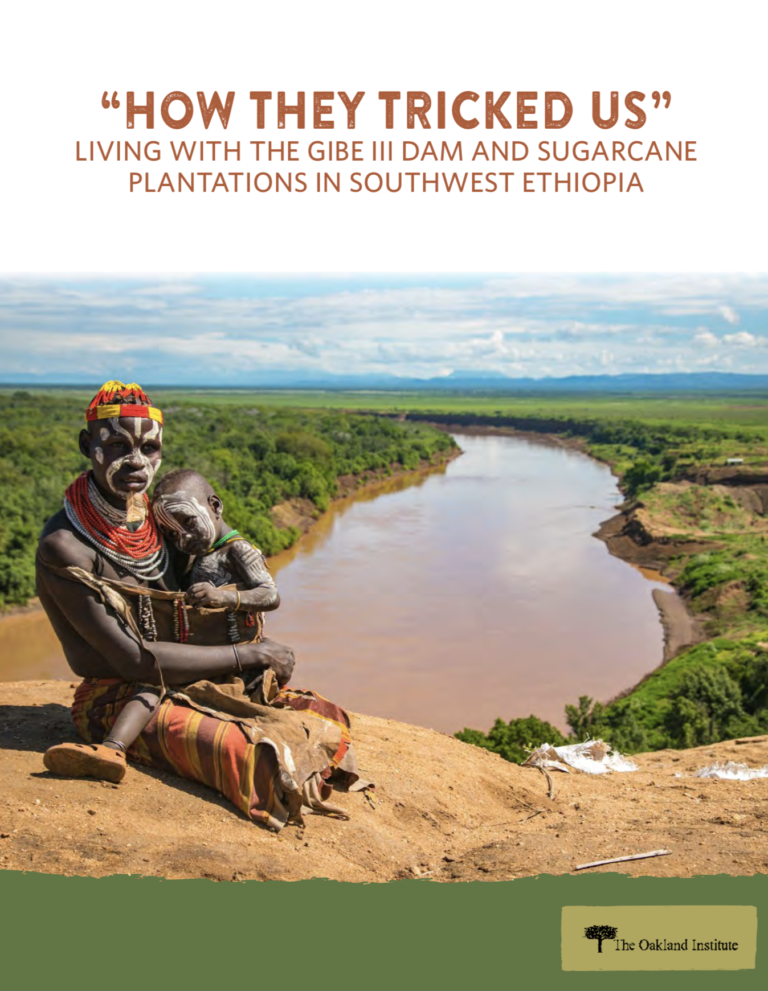
For over a decade, the Oakland Institute has raised alarm about the conditions and threats that both the Gibe III Dam and the Kuraz Sugar Development Project pose for Indigenous communities in the region. Now, several years on, new research conducted among local communities reveals the true impact on those who have called the area home for centuries, in particular the Bodi, Mursi, and Northern Kwegu. The findings call for urgent action by the new government that has been led by Dr. Abiy Ahmed since April 2018.

“How They Tricked US” Living with the Gibe III Dam and Sugarcane Plantations in Southwest Ethiopia DOWNLOAD

post

page

attachment

revision

nav_menu_item

custom_css

customize_changeset

oembed_cache

user_request

wp_block

wp_template

wp_template_part

wp_global_styles

wp_navigation

wp_font_family

wp_font_face

acf-taxonomy

acf-post-type

acf-field-group

acf-field

ai1ec_event

exactmetrics_note

Human Trafficking in America’s Schools
GuidancePublications

This guide provides an introduction of human trafficking for educators.  The guide discusses risk factors, indicators of human trafficking, the impact on the learning environment, school protocols, and resources for school staff. ...Read More

Current and Potential Impacts of Legal Reforms on Businesses and Workers in Thailand’s Fishing Industry
Publications

While some challenges around design and implementation remain, the aim of the reforms- to improve conditions for workers in the sector, help to restore Thailand's depleted fish stocks and ultimately to make the industry more safe, sustainable and pr...Read More

Leaning In: Advancing the Role of Finance Against Modern Slavery
Publications

This report on modern slavery and financial institutions by the Royal United Services Institute for Defence and Security Studies and the Freedom Fund considers the role that the financial sector can play in reducing human trafficking and modern slave...Read More

The Corporate Social Responsibility Mirage
Publications

An article by Garrett Brown MPH, CIH Corporate social responsibility (CSR) programs began in the early 1990s with the promise of eliminating dangerous and illegal “sweatshops” in the global supply chains of world-renown corporations selling ...Read More