
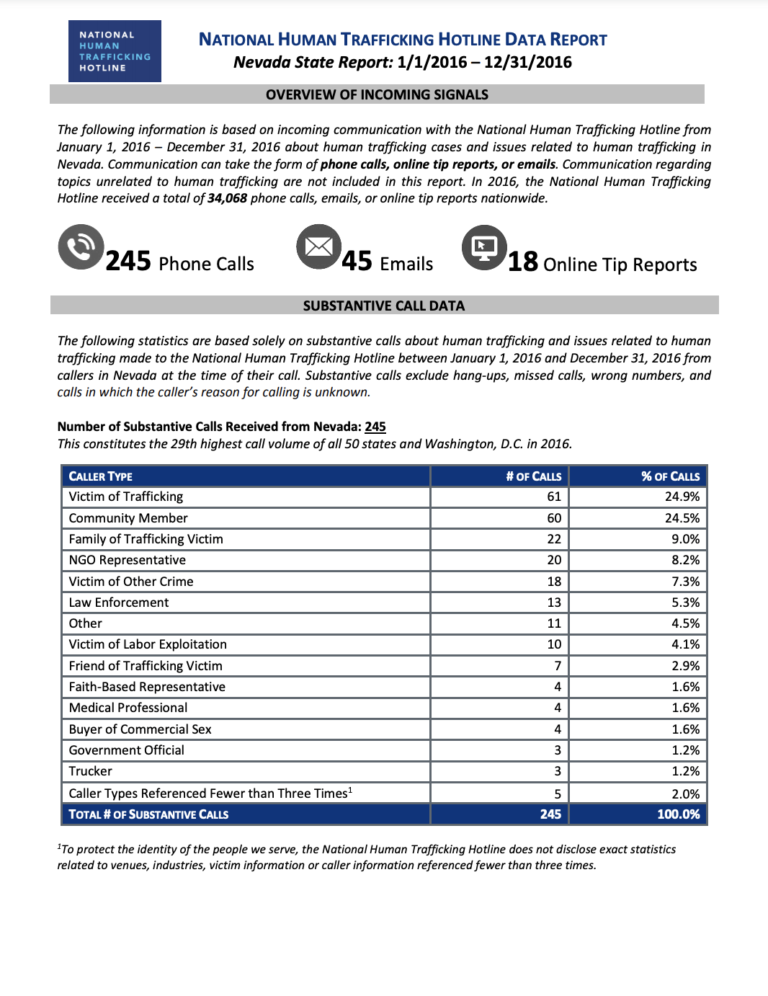
The following information is based on incoming communication with the National Human Trafficking Hotline from January 1, 2016 – December 31, 2016 about human trafficking cases and issues related to human trafficking in Nevada. 

National Hotline 2016 Nevada State Report - National Human Trafficking Hotline, 2017 DOWNLOAD

post

page

attachment

revision

nav_menu_item

custom_css

customize_changeset

oembed_cache

user_request

wp_block

wp_template

wp_template_part

wp_global_styles

wp_navigation

wp_font_family

wp_font_face

acf-taxonomy

acf-post-type

acf-field-group

acf-field

ai1ec_event

exactmetrics_note

Establishing an Agile Response Process to Crisis and Conflict-related Modern Slavery and Human Trafficking Risks
Publications

In a constantly changing world, financial institutions must continually adapt to new risk factors. Regional or global crises like war or natural disasters, in particular, can trigger or fuel criminal activity and related risks,1 including MS/HT...Read More

TAGS:
Impact of the CARE Tipping Point Program in Nepal on adolescent girls’ agency and risk of child, early, or forced marriage: Results from a cluster-randomized controlled trial
Publications

ackground: Girl child, early, and forced marriage (CEFM) persists in South Asia, with long-term effects on well- being. CARE’s Tipping Point Initiative (TPI) sought to address the gender norms and inequalities underlying CEFM by engaging part...Read More

TAGS:
Trapped: The Belt and Road Initiative’s Chinese Workers
News & AnalysisPublications

The Belt Road Initiative (BRI), China’s ambitious transnational development program, is set to redefine globalization with “Chinese characteristics.” Since its inception, thousands of transportation, energy, information technology, and mining ...Read More

Fishing For Data
Publications

Marine fisheries are critical resources for coastal developing countries. They are also difficult to manage sustainably. Almost a third of global fish stocks are degraded from overfishing, and a further 60% are ‘fully exploited’ (FAO, 2016). Ille...Read More