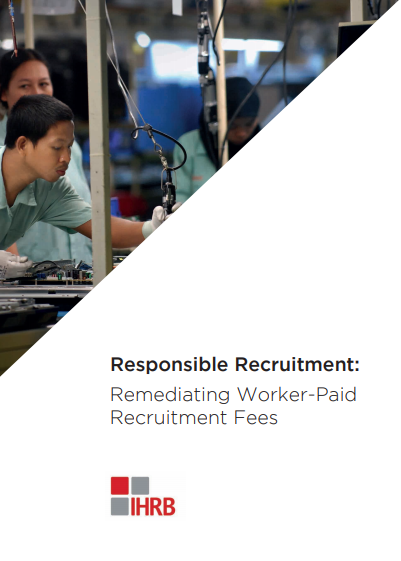
A major cause of forced labour in global supply chains is the charging of recruitment fees to migrant workers. Some companies have sought to reimburse workers charged these fees, many face serious challenges in doing so.

Reimbursing worker-paid fees is an important step consistent with the UN Guiding Principles on Business and Human Rights, which clarify the baseline expectation for companies to respect human rights, including providing for or cooperating in remediation when they have caused or contributed to adverse human rights impacts.

This report profiles six multi-national companies who have sought to address access to remedy by reimbursing workers found to have paid fees. Each of the remediation programmes vary in size and structure and have been shaped by the local contexts in which these companies operate. Together, they have provided a form of remedy for thousands of workers amounting to millions of dollars in the last decade.

Responsible Recruitment: Remediating Worker - Paid Recruitment Fees - IHRB, 2017 DOWNLOAD

post

page

attachment

revision

nav_menu_item

custom_css

customize_changeset

oembed_cache

user_request

wp_block

wp_template

wp_template_part

wp_global_styles

wp_navigation

wp_font_family

wp_font_face

acf-taxonomy

acf-post-type

acf-field-group

acf-field

ai1ec_event

exactmetrics_note

Financial Industry: Modern Slavery Awareness Survey
Publications

When asked the importance of the following social and environmental issues at a personal level, over four fifths (87%) of financial services employees rate modern slavery and human trafficking as important. ...Read More

Impact of the pandemic on the criminal justice system
COVID-19 resourcesPublications

This report provides a cross-system view of how the criminal justice system reacted in the immediate aftermath of the first national Covid-19 lockdown (23 March to 10 May 2020), and of how the system has managed since. The cumulative impact on th...Read More

National Hotline 2017 Washington State Report
Graphics & InfographicsPublications

The data in this report represents signals and cases from January 1, 2017 through December 31, 2017 and is accurate as of July 11, 2018. Cases of trafficking may be ongoing or new information may be revealed to the National Hotline over time. Conseq...Read More

Point of No Returns Part II – Human Rights: An assessment of asset managers’ approaches to human and labour rights
Publications

The number of modern slavery victims in global supply chains today is believed to stand at around 16 million, roughly the same number of enslaved people as during the transatlantic slave trade in the 18th century. While this statistic alone is sugge...Read More