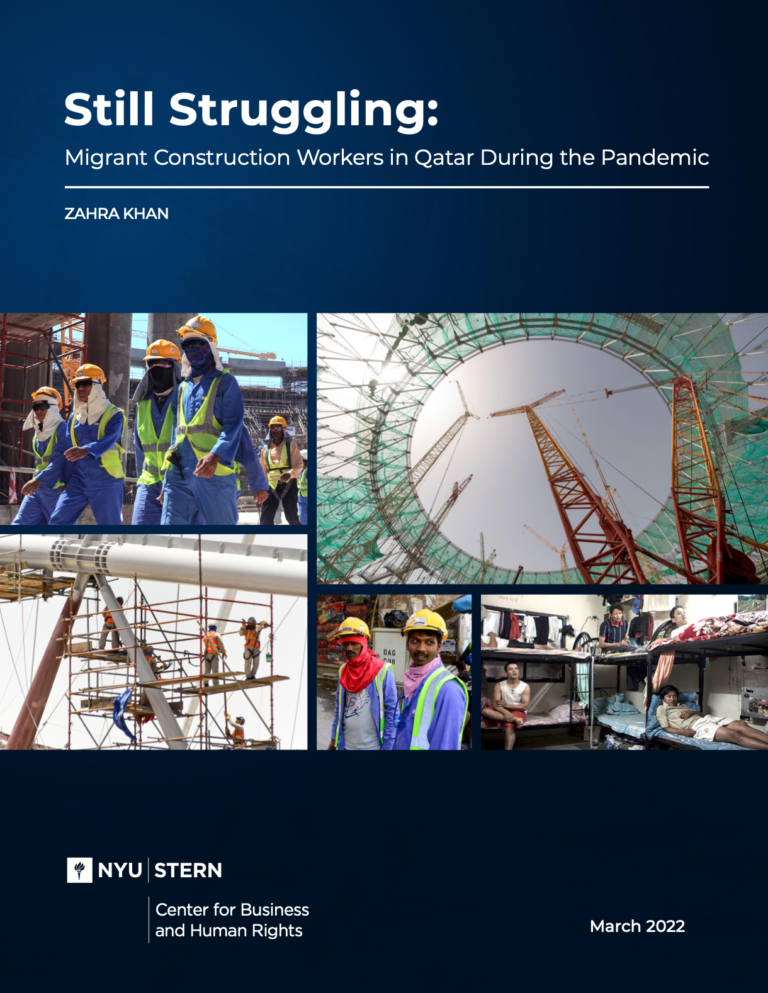
This report uses Qatar as a case study to examine how the global public health crisis affected destitute migrants in the Middle East and how employers and the government responded. It also makes a series of reform recommendations that would promote human rights by improving workers’ economic and living conditions.

The report’s central findings are two- fold: After a slow start, the government of Qatar provided migrant workers with free, adequate healthcare in response to the pandemic. But foreign laborers suffered economically as a result of construction delays, wage reductions, terminated contracts, and deportations. The contrast between the government’s vigorous public health campaign and its failure to protect workers’ livelihoods is key. Qatar should address migrants’ economic needs with the same energy and resourcefulness illustrated by its efforts to stem the spread of Covid-19.

Still Struggling: Migrant Construction Workers in Qatar During the Pandemic- Zahra Kahn (NYU Stern School of Business), March 2022 DOWNLOAD

post

page

attachment

revision

nav_menu_item

custom_css

customize_changeset

oembed_cache

user_request

wp_block

wp_template

wp_template_part

wp_global_styles

wp_navigation

wp_font_family

wp_font_face

acf-taxonomy

acf-post-type

acf-field-group

acf-field

ai1ec_event

exactmetrics_note

The other side of the storm: What do black immigrant domestic workers in the time of Covid-19 teach us about building a resilient care infrastructure?
Guidance

With the persistent reality of COVID-19 virus resurgence, our nation’s policymakers have turned their attention to making investments that strengthen the resilience of our families, communities, and the national infrastructure in the face of inevi...Read More

Regional Overview: Combating the Sexual Exploitation of Children in South Asia
GuidancePublications

This report maps sexual exploitation of children in travel and tourism (SECTT), online child sexual exploitation (OCSE), trafficking of children for sexual purposes, sexual exploitation of children through prostitution, child early and forced marria...Read More

Migrant workers’ access to justice for wage theft: A global study of promising initiatives
Guidance

Systemic wage theft has long been part of the labour migration landscape in every region of the world. During COVID-19, egregious underpayment of migrant workers was even more widespread as businesses encountered financial pressures and vast numbers...Read More

Disrupting harm in Uganda: Evidence on online child sexual exploitation and abuse
Guidance

Funded by the Global Partnership to End Violence against Children, through its Safe Online initiative, ECPAT, INTERPOL, and UNICEF Office of Research – Innocenti worked in partnership to design and implement Disrupting Harm – a mu...Read More