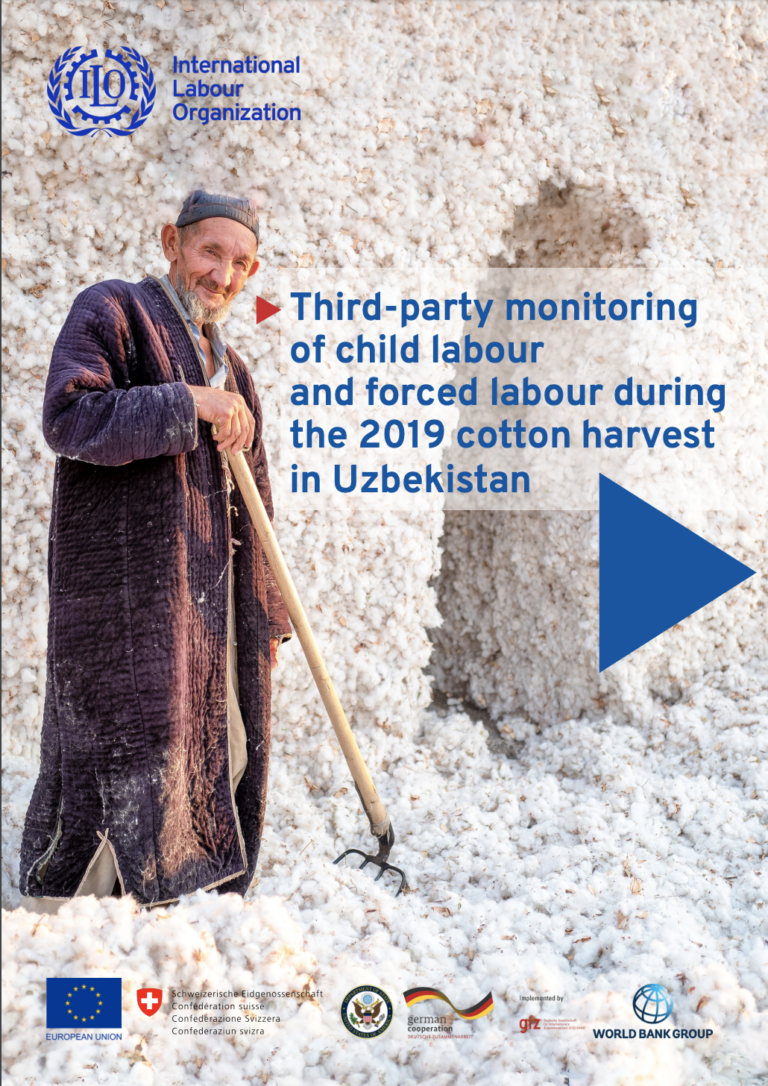
This report has been prepared by the International Labour Office pursuant to an agreement between the International Labour Organization (ILO) and the World Bank to carry out third-party monitoring on the incidence of child labour and forced labour in the World Bank-financed projects in agriculture, water and education sectors in Uzbekistan. Third-party monitoring by the ILO was also undertaken and reported on annually since 2015.

Uzbekistan continued to demonstrate major progress in the eradication of child labour and forced labour in the 2019 cotton harvest. As in previous years, there were only isolated cases of minors below the legal working age picking cotton. The number of people in forced labour during the harvest was reduced by 40 percent compared to 2018.

The ILO has taken into account all the different comments and inputs it has received throughout the monitoring process from national governmental and non-governmental organizations, including Uzbek civil society representatives. In line with the request of its partners in Uzbekistan, in particular the Government, this report contains concrete suggestions for action. It also points out further opportunities for cooperation between the partners in Uzbekistan and the ILO and the World Bank

Third-party monitoring of child labour and forced labour during the 2019 cotton harvest in Uzbekistan - International Labour Organization, 2020 DOWNLOAD

post

page

attachment

revision

nav_menu_item

custom_css

customize_changeset

oembed_cache

user_request

wp_block

wp_template

wp_template_part

wp_global_styles

wp_navigation

wp_font_family

wp_font_face

acf-taxonomy

acf-post-type

acf-field-group

acf-field

ai1ec_event

exactmetrics_note

Does monitoring improve labour standards? Lessons from Nike
Publications

Using a unique data set based on factory audits of working conditions in over 800 of Nike's suppliers in 51 countries, this paper seeks to explore whether or not monitoring for compliance with corporate codes of conduct -- currently the principal wa...Read More

TAGS:
Disrupting Harm in Kenya
Publications

Funded by the Global Partnership to End Violence against Children, through its Safe Online initiative, ECPAT, INTERPOL and UNICEF Office of Research – Innocenti worked in partnership to design and implement a multifaceted research project on onlin...Read More

Using SAS® Text Analytics to Assess International Human Trafficking Patterns
Good PracticesPublications

By Tom Sabo, Adam Pilz, SAS Institute Inc. Abstract  The US Department of State (DOS) and other humanitarian agencies have a vested interest in assessing and preventing human trafficking in its many forms. A subdivision within the DOS releases pub...Read More

The Government’s response to COVID-19: human rights implications related to modern slavery
COVID-19 resourcesPublications

Victims of modern slavery are amongst the most vulnerable people in society. They face additional risks due to the COVID-19 outbreak, as a result of isolation, economic instability, and reduced access to support services. This publication covers:...Read More

TAGS: Europe