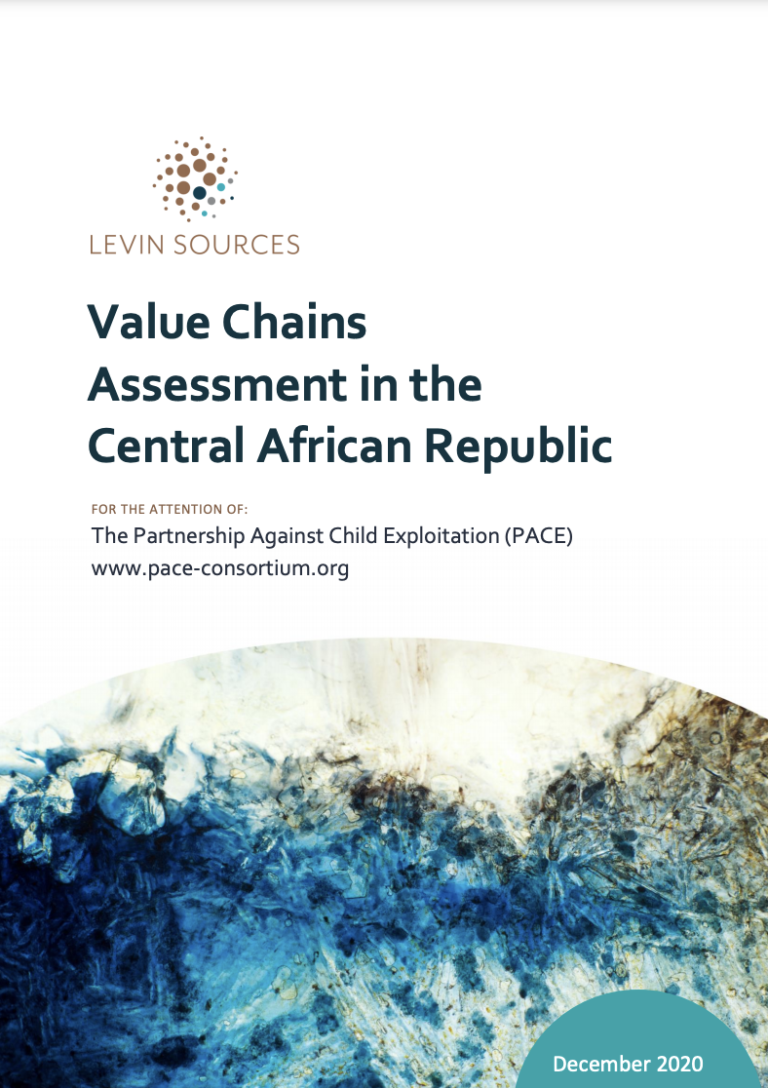
Conducted between February-September 2020, the assessment draws on both desk-based literature, key stakeholder interviews and field research conducted in Bangui, Bossangoa, Bocaranga and Yaloke, as well as internationally.

The report presents the different stages of the gold value chain in CAR from mining to export and further downstream, comparing the regulatory framework with the reality of gold flows and actors involved in gold mining and trade. It describes both primary and secondary activities in the value chain, profiling the actors involved, providing a view of livelihoods and revenues at each stage, and highlights barriers and opportunities related to them.

Value Chains Assessment in the Central African Republic - Levin Sources, 2020 DOWNLOAD

post

page

attachment

revision

nav_menu_item

custom_css

customize_changeset

oembed_cache

user_request

wp_block

wp_template

wp_template_part

wp_global_styles

wp_navigation

wp_font_family

wp_font_face

acf-taxonomy

acf-post-type

acf-field-group

acf-field

ai1ec_event

exactmetrics_note

Finance & human rights: regulatory overview
GuidancePublications

This short paper is intended as a general overview of the development of different legislations and frameworks that apply in the area of finance and human rights, underlining key aspects. It comprises EU regulation (in force and upcoming), national ...Read More

Working in Marks and Spencer’s food and footwear supply chains
Publications

Marks & Spencer (M&S) sets itself high standards. Its Plan A was widely recognized as breaking new ground in sustainability reporting when it was launched in 2016. In addition, M&S has achieved high rankings on human rights indices and, ...Read More

The Fair Food Program 2017 Annual Report
Publications

This is the fourth report of the Fair Food Standards Council on the state of the Fair Food Program. It provides the most recent results and analysis from Seasons 5 and 6 of the Program’s implementation. However, unlike past reports, the 2017 versio...Read More

Developing Freedom: The Sustainable Development Case for Ending Modern Slavery, Forced Labour and Human Trafficking
Publications

40.3 million people – around 1 in every 185 people alive – experienced modern slavery or forced labour in 2016. States have committed to take immediate and effective measures to end modern slavery, forced labour and human trafficking by 2030, an...Read More