
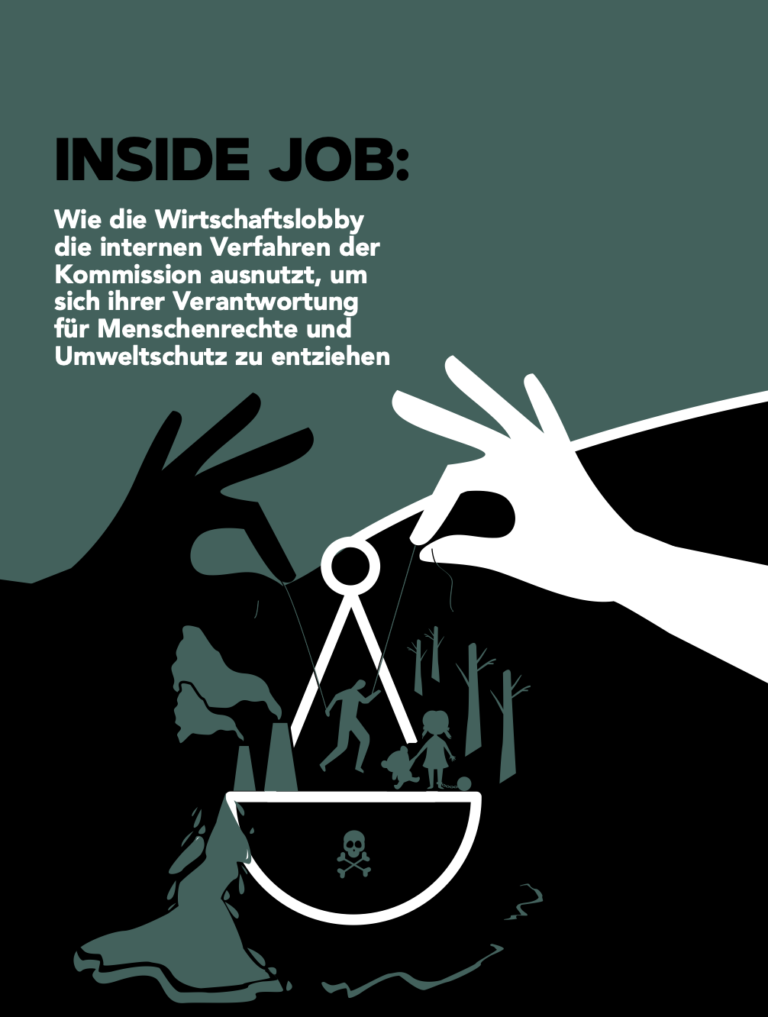
A proposed EU law that seeks to hold companies accountable for human rights abuses, climate change, and environmental destruction has been severely watered down by corporate lobbyists, with assistance from the European Commission’s own business-friendly ‘Better regulation’ agenda which includes the Regulatory Scrutiny Board (RSB). The RSB’s deregulatory mission helps to ensure the costs of social and environmental damage caused by corporations are paid for by society, not the companies themselves. As a result a law originally intended to limit corporate impunity, requiring companies to exercise ‘due diligence’ along their global supply chains, and provide affected people with access to justice, has been left full of major loopholes.

Inside job: How business lobbyists used the Commission's scrutiny procedures to weaken human rights and environmental legislation - BUND, Corporate Europe Observatory, and Friends of the Earth Europe_ English, June 2022 DOWNLOAD
Inside job: How business lobbyists used the Commission's scrutiny procedures to weaken human rights and environmental legislation - BUND, Corporate Europe Observatory, and Friends of the Earth Europe, June 2022_German DOWNLOAD

post

page

attachment

revision

nav_menu_item

custom_css

customize_changeset

oembed_cache

user_request

wp_block

wp_template

wp_template_part

wp_global_styles

wp_navigation

wp_font_family

wp_font_face

acf-taxonomy

acf-post-type

acf-field-group

acf-field

ai1ec_event

exactmetrics_note

Purchasing practices and factory-level noncompliances: How the available research can inform supply chain due diligence
News & Analysis

The report provides insight into how current research on purchasing practices and factory-level noncompliance can inform supply chain due diligence. Buyer purchasing practices most strongly impact working time, contracts, HR and compensation, with s...Read More

TAGS: Global
Design of a Privacy-Preserving Data Platform for Collaboration Against Human Trafficking
News & AnalysisGuidanceGood PracticesGraphics & Infographics

Case records on identified victims of human trafficking are highly sensitive, yet the ability to share such data is critical to evidence-based practice and policy development across government, business, and civil society. We propose new methods to...Read More

Was Your Seafood Caught With Slave Labor? New Database Helps Retailers Combat Abuse
News & AnalysisOnline Tools

The NPR article highlights ongoing forced labor and human trafficking in the global seafood industry, especially in Thailand. In response, the Monterey Bay Aquarium’s Seafood Watch launched the Seafood Slavery Risk Tool to help retailers assess an...Read More

New Study on Human Trafficking for Labour Exploitation in Peru’s Logging and Gold Mining Sectors.
News & AnalysisPublications

A new study conducted by IOM and the Catholic University of Peru sheds new light on human trafficking for labour exploitation in illegal logging and gold mining in the Madre de Dios region of the country. Peru is a country of origin, transit and de...Read More