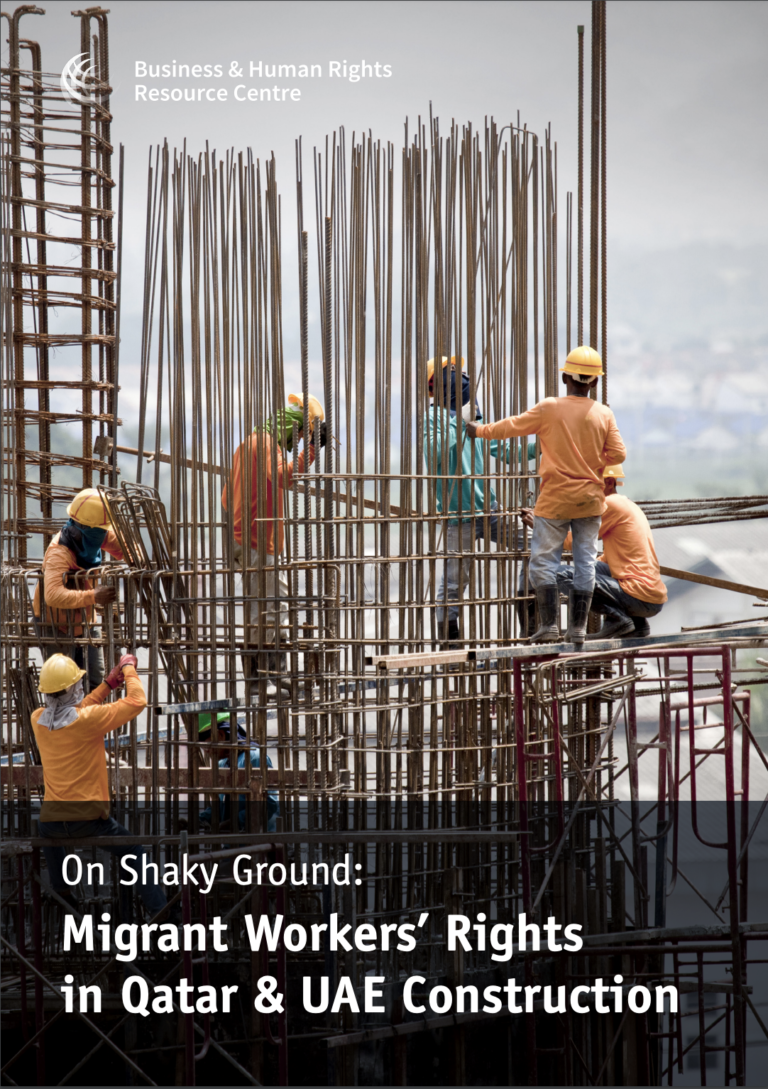
Prompted by international scrutiny of working conditions on flagship projects in Qatar and the UAE, in 2016, the Business & Human Rights Resource Centre surveyed construction companies on their approach to safeguarding migrant workers’ rights in both countries.

Two years on and with a second survey, the findings show that while a consistent but small group of construction companies demonstrate real commitment to tackling the risks to migrant workers in their operations, the overwhelming majority operate with high risks to human rights and continued disregard for workers’ welfare. In both years, more than 70% of surveyed companies did not respond and over 60% did not have a public commitment to human rights.

This briefing analyses the survey responses and public human rights commitments of construction companies with current projects in the region and makes recommendations to companies, clients and governments to advance the rights of migrant workers.

On Shaky Ground: Migrant Workers’ Rights in Qatar & UAE Construction - Business & Human Rights Resource Centre, 2019 DOWNLOAD

post

page

attachment

revision

nav_menu_item

custom_css

customize_changeset

oembed_cache

user_request

wp_block

wp_template

wp_template_part

wp_global_styles

wp_navigation

wp_font_family

wp_font_face

acf-taxonomy

acf-post-type

acf-field-group

acf-field

ai1ec_event

exactmetrics_note

Practical Infosheets for Child Protection Intervention – COVID-19
COVID-19 resourcesGuidance

The COVID-19 pandemic has had a huge impact on the practice of many professionals, including those in the field of child protection. In order to support front line workers and managers in their work to protect children during this ...Read More

Supply Chain Sustainability: A Practical Guide for Continuous Improvement, Second Edition
Guidance

This second edition of Supply Chain Sustainability: A Practical Guide to Continuous Improvement is aimed at reflecting the new and emerging trends in this area since its original launch in 2010 as well as ensuring the inclusion of and alignment with ...Read More

Forced labor in supply chains: Addressing risks and safeguarding workers’ freedoms
Guidance

Forced labor, trafficking, and modern slavery (referred to collectively herein as forced labor) are human rights abuses persistent in global supply chains. The International Labour Organization (ILO) estimates that, in 2016, 16 million people&n...Read More

Preventing Modern Slavery and Human Trafficking: An Agenda for Action across the Financial Services Sector
Guidance

There are over 40 million people in modern slavery worldwide. Modern slavery exists in every industry, in every country in the world. The financial services industry has a major role to play in combating this violent and abusive business. And yet ou...Read More