
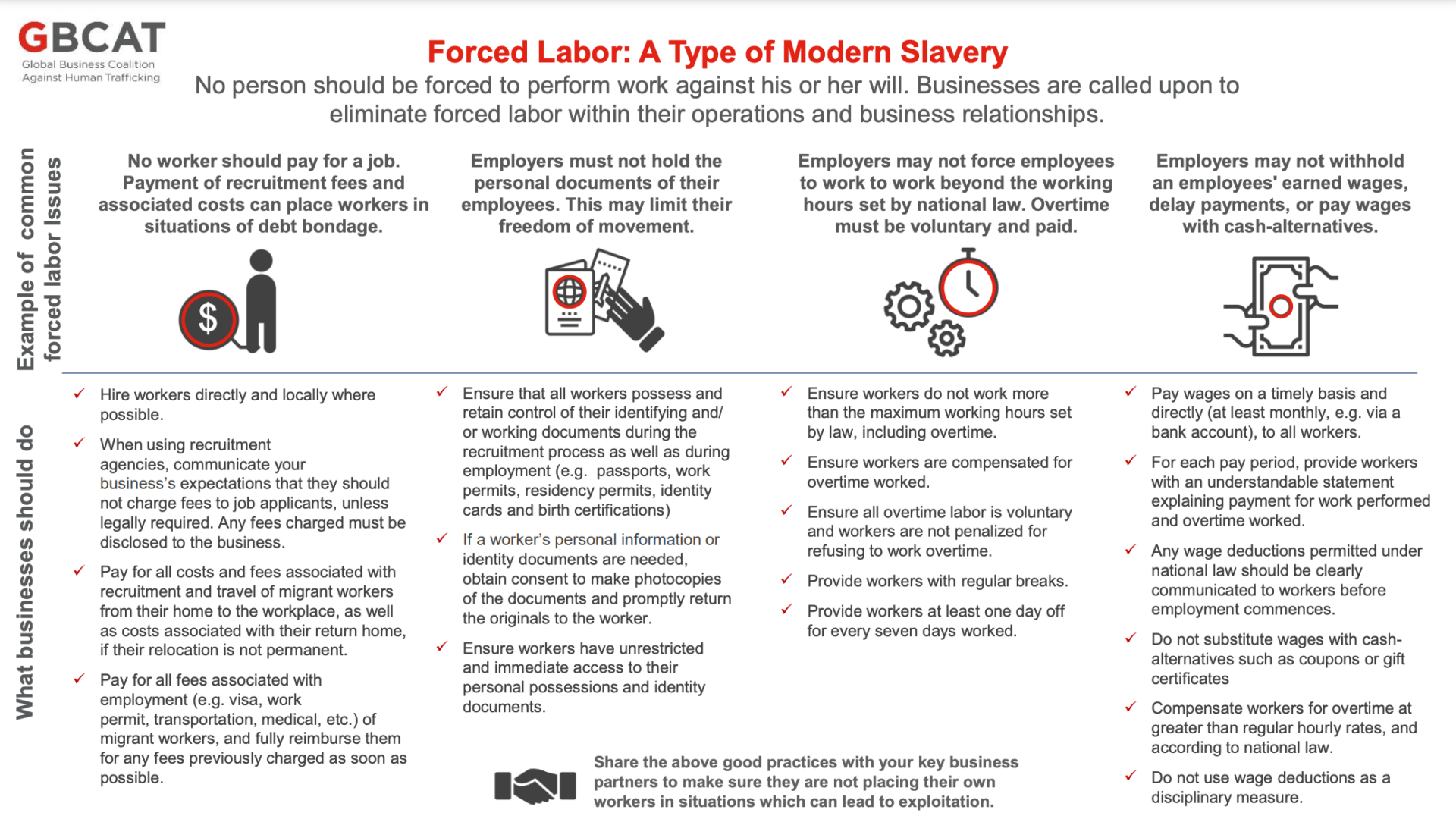
This toolkit aims to help companies that work in corporate supply chains to quickly identify areas of their business which carry the highest risk of modern slavery and develop a simple plan to prevent and address any identified risks. It is designed particularly for small and medium-sized enterprises (SMEs), which typically face the greatest modern slavery risks across supply chains, but can be considered a resource for companies of all sizes as they get started.

Addressing Forced Labor and other Modern Slavery Risks: A Toolkit for Small and Medium-Sized Suppliers - Global Business Coalition Against Human Trafficking, 2020 DOWNLOAD

post

page

attachment

revision

nav_menu_item

custom_css

customize_changeset

oembed_cache

user_request

wp_block

wp_template

wp_template_part

wp_global_styles

wp_navigation

wp_font_family

wp_font_face

acf-taxonomy

acf-post-type

acf-field-group

acf-field

ai1ec_event

exactmetrics_note

Final Evaluation: Forced Labor Indicators Project
Guidance

In April 2021, the Government of Ghana (GOG) launched its Ten-Year Action Plan on the Eradication of Child Labor, Forced Labor, Human Trafficking and Modern Slavery in Africa (2020-2030): African Union Agenda 2063 – Sustainable Development Goal (S...Read More

Measuring Disclosure Quality of Modern Slavery Statements: A SX300 Companies
Guidance

Modern slavery is a global phenomenon, with 40.3 million victims and $354 billion at-risk products imported by G20 countries in one year alone, according to estimates by the Walk Free Foundation (2018). Australia has historically been complicit in t...Read More

Review of the Nestlé Palm Oil Upstream Supply Chain Management Program in Malaysia and Indonesia
Guidance

In recent years, labour practices in the palm oil sector in Southeast Asia have drawn significant attention from both media and civil society actors. In June 2018, Nestlé began a partnership with Verité on a multiyear program to improve ...Read More

Gender-Responsive Guidance on Employment Contracts for Migrant Domestic Workers from South Asia
Guidance

Domestic workers are often partially or fully excluded from national labour laws and related protections. The lack of comprehensive legal protection for domestic workers means employment contracts play a critical role in establishing protections of ...Read More