
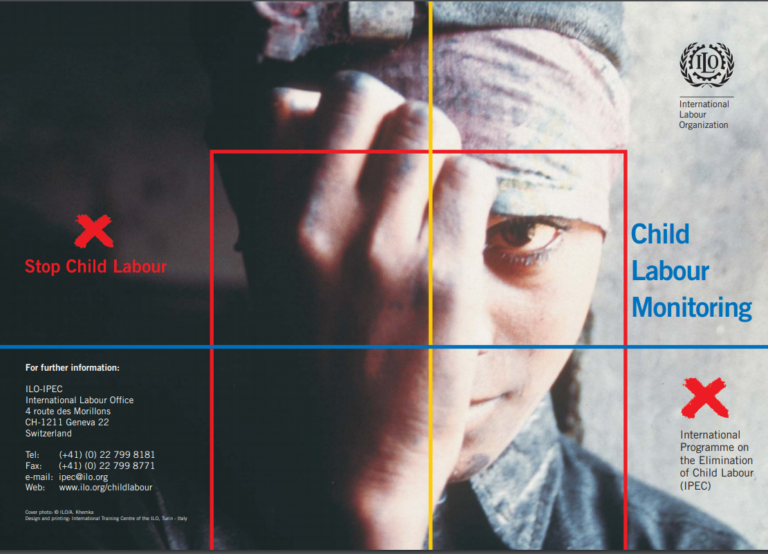
This resource developed by the ILO International Programme on the Elimination of Child Labour (IPEC), provides information on how to design, develop and operate child labour monitoring systems along with practical examples that will help to adapt the model to specific child labour situations.

Child Labour Monitoring Resource Kit, International Labour Organization (ILO), 2005 DOWNLOAD

post

page

attachment

revision

nav_menu_item

custom_css

customize_changeset

oembed_cache

user_request

wp_block

wp_template

wp_template_part

wp_global_styles

wp_navigation

wp_font_family

wp_font_face

acf-taxonomy

acf-post-type

acf-field-group

acf-field

ai1ec_event

exactmetrics_note

National Referral Mechanism on Identifying and Working with Potential Victims of Child Trafficking
GuidancePublications

Since its establishment in 2007, the Working Group on Child Trafficking as a sub-group of the Task Force on Combating Human Trafficking has been working to gather background information on the phenomenon of child trafficking in Austria through the e...Read More

The BankTrack Human Rights Benchmark 2019
Publications

BankTrack’s Human Rights Benchmark evaluates 50 of the largest private sector commercial banks globally against a set of 14 criteria based on the requirements of the UN Guiding Principles on Business and Human Rights(‘the Guiding Principles’)....Read More

A Human Rights Primer for Business: Understanding Risks to Construction Workers in the Middle East
Publications

Employment in the construction industry is characterised by low wages and precarious working conditions, with aspects of the business model contributing to widespread violations of workers’ labour rights. These include: a narrowmargin, least-cost ...Read More

German Supply Chain Due Diligence Law
Publications

International trade and business operations by German and European companies represent an opportunity to create jobs and generate prosperity along global supply chains. On the downside, these activities can also have substantial negative effects on ...Read More