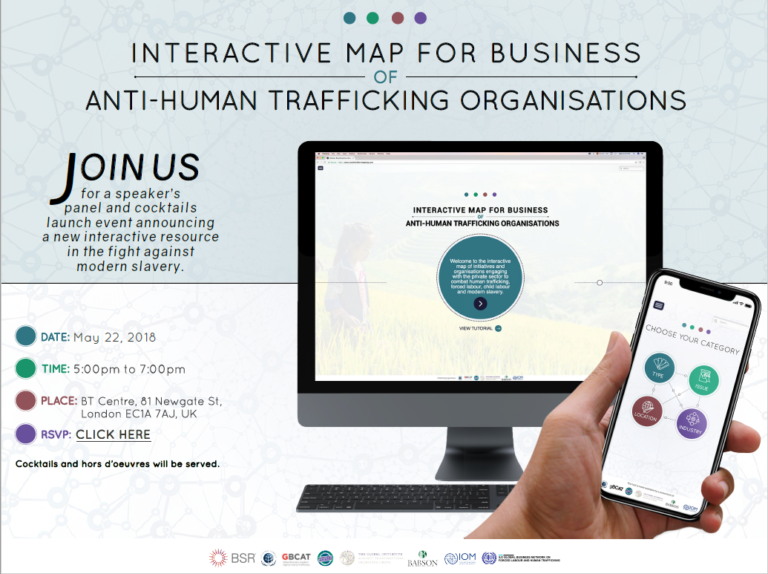
The Interactive Map for Business of Anti-Human Trafficking Organisations (www.modernslaverymap.org) and the accompanying report are designed with the following in mind:
The private sector – to help companies navigate emerging partners and resources;
All anti-trafficking organisations; and
The general public
With 75 organisations and initiatives included, who are working on five human-trafficking-related issues (child labour, forced labour, etc.), covering eleven industries and eight regions, the Interactive Map for Business of Anti-Human Trafficking Organisations aims to improve coordination on the eradication of modern slavery, and provides a unique baseline from which existing and newly formed initiatives can move forward.
The Launch event was held at BT Centre, 81 Newgate Street, London, EC1A, United Kingdom on 22 May, 2018, 5:00–7:00 pm (BST). The event was also livestreamed on RESPECT Youtube channel.
The Investor Alliance for Human Rights hosted this webinar to inform how institutional investors can be connected to harmful impacts on human rights defenders through their investments.
https://www.youtube.com/watch?v=iI3GGOMTkEk
...Read More
US seafood company Bumble Bee, one of the leading companies in the canned tuna market with nearly 90% consumer awareness levels, and its Taiwanese parent company Fong Chun Formosa Fishery Company (hereinafter referred to as FCF), one of the top thre...Read More
Large numbers of young people in Southeast Asia seek work opportunities outside their country of origin, migrating both regularly and irregularly, and with little power to access or negotiate safe and fair migration and work conditions. The risk of ...Read More
The Free2Work App 2.0, launched by Not For Sale and the International Labor Rights Forum, empowers consumers to make ethical shopping choices by providing instant access to information on companies’ efforts to eliminate forced and child labor. Wit...Read More