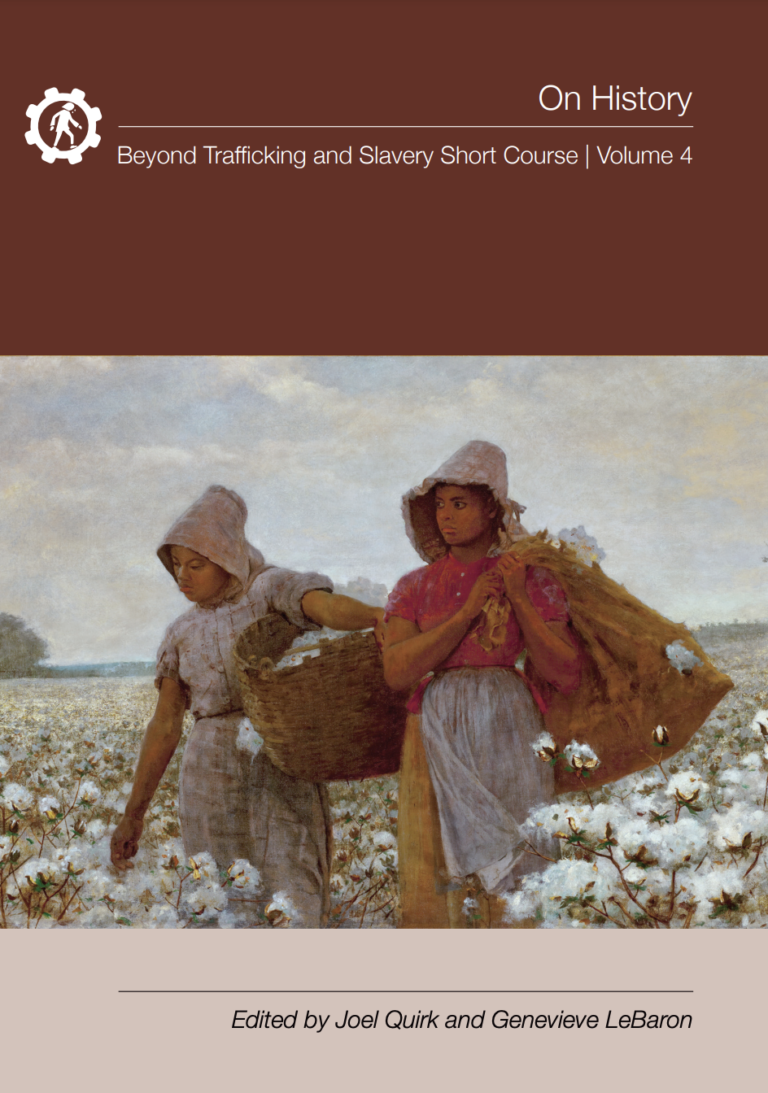
Edited by Joel Quirk and Genevieve LeBaron.

This is the fourth volume of the series Beyond Trafficking and Slavery Short Course.

Campaigners and governments leading the fight to end ‘modern-day slavery’ selectively appeal to history to help justify their current activities. They uncritically praise Anglo-Saxon anti-slavery efforts, but have remarkably little to say about the larger history of enslavement, slave resistance, or the contemporary legacies of historical slave systems. Centuries of severe exploitation, racial subjugation, and violent abuse have too often been lost in the rush to celebrate the ‘moral triumph’ of abolition. The legal abolition of slavery was not a gift from great emancipators. Nor did it mark an end to the need for resistance. Former slaves were never compensated for their decades of toil and abuse, and their former masters made every effort to defend their privileges, contributing to global patterns of wealth, poverty, inequality, and discrimination that remain with us to this day.

On History - openDemocracy, 2015 DOWNLOAD

post

page

attachment

revision

nav_menu_item

custom_css

customize_changeset

oembed_cache

user_request

wp_block

wp_template

wp_template_part

wp_global_styles

wp_navigation

wp_font_family

wp_font_face

acf-taxonomy

acf-post-type

acf-field-group

acf-field

ai1ec_event

exactmetrics_note

Trapped: The Belt and Road Initiative’s Chinese Workers
News & AnalysisPublications

The Belt Road Initiative (BRI), China’s ambitious transnational development program, is set to redefine globalization with “Chinese characteristics.” Since its inception, thousands of transportation, energy, information technology, and mining ...Read More

Promoting Responsible Recovery: Detecting, Mitigating, and Remediating Modern Slavery in Supply Chains Session 2
PublicationsWebinars

This briefing forms part of a broader five session series of webinars standing to tackle contemporary issues impacting modern slavery in supply chains, calling for candid discussion and pragmatic solutions. Workers themselves know better than any...Read More

Workers’ conditions in the textile and clothing sector: just an Asian affair? Issues at stake after the Rana Plaza tragedy
Publications

Written by Enrico D'Ambrogio More than 70% of EU imports of textile and clothing come from Asia. Many Asian workers have to work in sweatshop conditions, but the issue appears in global media only when major fatal accidents occur, like that at Ra...Read More

Measurement Action Freedom – An independent assessment of government progress towards achieving UN Sustainable Development Goal 8.7
Publications

No country in the word is exempt from modern slavery. Regardless of size, population or wealth, this insidious crime permeates national borders and global supply chains. Even in countries with seemingly strong laws and systems, there are critica...Read More

TAGS: Global