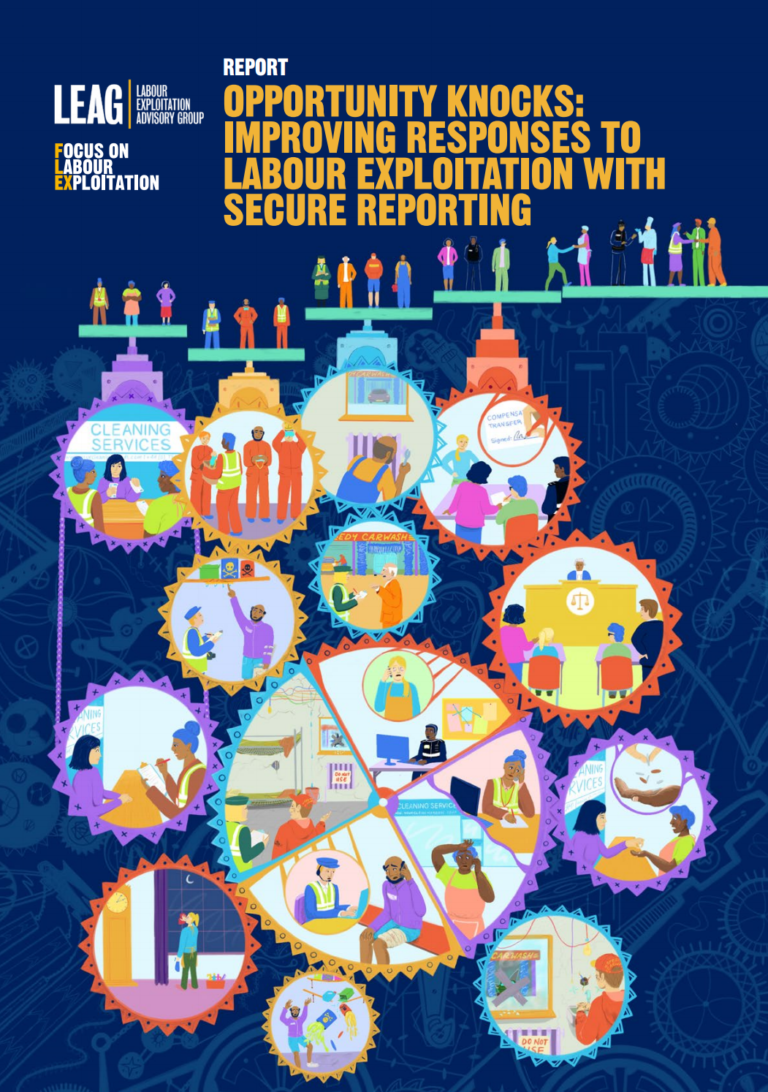
The research examines the practices and policies of labour inspectorates and the Metropolitan Police and their relationship with the Home Office’s Immigration Enforcement team. Findings are based on these agencies engagement with immigration enforcement action; frontline organisations’ experience supporting migrant workers; and cases of people who have insecure immigration status and have chosen not to report to statutory agencies as a result.

‘Insecure immigration status’ refers to migrants, both documented and undocumented, who are currently required to prove they have a ‘right to work’ in the UK and who experience barriers accessing support or enforcing their rights.

This group covers people who are lawfully in the UK but are banned from working as a result of visa restrictions (e.g. tourist visas), have limitations to their ‘right to work’ (e.g. students working more than 20 hours per week), subject to other conditions that restrict their access to employment in the UK (e.g. asylum-seekers, some potential victims of modern slavery offences who are currently in the National Referral Mechanism), European nationals and people on work-visas who face barriers reporting issues at work due to a limited understanding of their rights and entitlements in the UK. It also includes those with undocumented status, such as people who have irregularly entered or stayed in the country, whose leave to enter or remain has expired or has been denied (e.g. negative asylum claims).

Opportunity Knocks: improving responses to labour exploitation with secure reporting - Labour Exploitation Advisory Group, 2020 DOWNLOAD

post

page

attachment

revision

nav_menu_item

custom_css

customize_changeset

oembed_cache

user_request

wp_block

wp_template

wp_template_part

wp_global_styles

wp_navigation

wp_font_family

wp_font_face

acf-taxonomy

acf-post-type

acf-field-group

acf-field

ai1ec_event

exactmetrics_note

Garment supply chains in intensive care? Human rights due diligence in times of (economic) crises
COVID-19 resourcesPublications

The new coronavirus (COVID-19) affects almost every area of people’s lives and economic activity and has led to a significant disruption of world trade. The current situation demonstrates how precarious our global systems of production and consump...Read More

Impact of mobile technology for survivors of modern slavery and human trafficking: A mixed method study
Publications

Enabling access to online services through mobile technology is an essential need for survivors during the Covid-19 pandemic. It should be considered a feasible and necessary element of survivor support packages outside a pandemic. Further research ...Read More

National Hotline 2018 Maine State Report
Graphics & InfographicsPublications

The data in this report represents signals and cases from January 1, 2018 through December 31, 2018 and is accurate as of July 25, 2019. Cases of trafficking may be ongoing or new information may revealed to the National Hotline over time. Consequen...Read More

Supporting Bright Futures – Young Women and Girls and Labour Migration in South-East Asia and the Pacific
Publications

At first glance, this research publication may seem niche, perhaps relevant only to “fringe” aspects of international migration. Historically, we know from decades of studies, data collection and analysis that there has been a strong bias toward...Read More