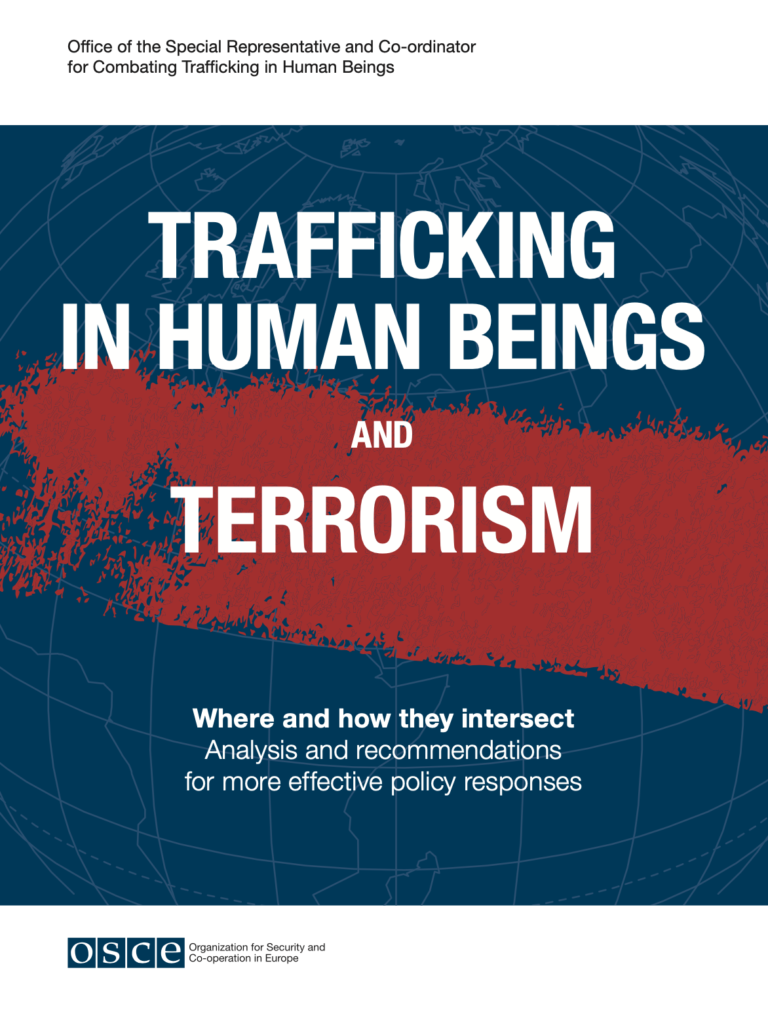
Since trafficking in human beings continues to evolve, with criminals employing ever more sophisticated, a multi-disciplinary approach to combat trafficking is not only recommended but necessary. In recent years, several reports have emerged alluding to the nexus between terrorism and trafficking in human beings, including within the OSCE region. To better understand the intersection between these two distinct and complex crimes, this paper critically reviews normative and policy frameworks governing action against human trafficking and terrorism. It also examines exploitative activities of terrorist groups through a human trafficking lens, including illustrative examples that contain indications of trafficking elements, whereby it explores how anti-trafficking mechanisms can be leveraged when dealing with terrorism to identify and pro- tect trafficking victims and prosecute perpetrators. Finally, it provides insights into various ways to prevent trafficking of vulnerable adults and children targeted by terrorist groups for various exploitative purposes. The paper offers a structured analysis presented in three chapters and concludes with targeted recommendations.

Trafficking in Human Beings and Terrorism: Where and How They Intersect - Office of the Special Representative and Co-ordinator for Combating Trafficking in Human Beings, 2021 DOWNLOAD

post

page

attachment

revision

nav_menu_item

custom_css

customize_changeset

oembed_cache

user_request

wp_block

wp_template

wp_template_part

wp_global_styles

wp_navigation

wp_font_family

wp_font_face

acf-taxonomy

acf-post-type

acf-field-group

acf-field

ai1ec_event

exactmetrics_note

Labour exploitation and public procurement: Guide for risk management in national supply chains.
Guidance

Over the past decade, businesses have in many ways improved their efforts to pro- mote human rights through sustainability measures. Simultaneously, political interest in strengthening corporate social responsibility has increased along with un...Read More

Trafficking Victim Identification: A Practitioner’s Guide
Guidance

This Practitioner Guide distills and presents existing research and evidence on the identification (and non-identification) of trafficking victims, including challenges and barriers that may impede victim identification and practices that may enhanc...Read More

Accountability and Remedy in Global Supply Chains: Considerations for Workers and Unions
GuidancePublications

For decades, workers, unions, students, and labour NGOs have joined together to try to hold global corporations accountable for the labour violations that have routinely taken place in their supply chains. Multi-faceted and often lengthy corporate c...Read More

TAGS: Global
Addressing Forced Labor and other Modern Slavery Risks: A Toolkit for Small and Medium-Sized Suppliers
GuidanceGraphics & Infographics

This toolkit aims to help companies that work in corporate supply chains to quickly identify areas of their business which carry the highest risk of modern slavery and develop a simple plan to prevent and address any identified risks. It is designed...Read More