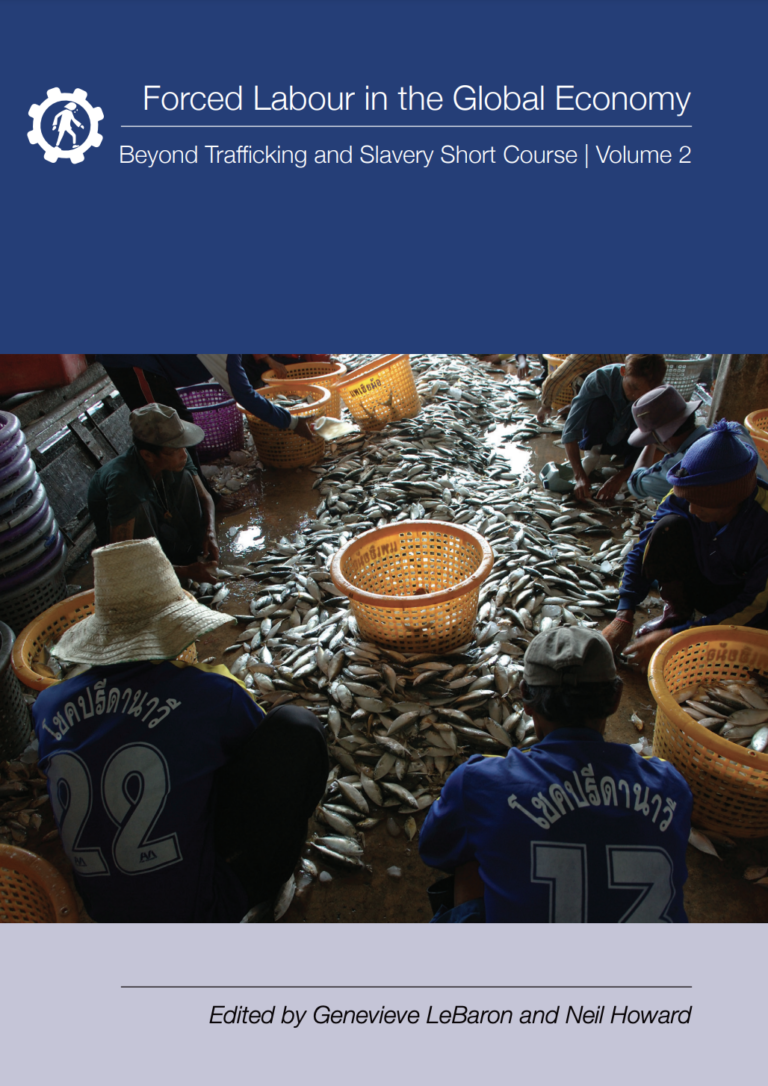
Edited by Genevieve LeBaron and Neil Howard.

This is the second volume of the series Beyond Trafficking and Slavery Short Course.

There is a growing and sober awareness among international policymakers and within global civil society that human trafficking, slavery and forced labour are not anomalies perpetuated by a few ‘bad apple’ employers. Rather, such severe labour exploitation is an endemic feature of the contemporary global economy. This edited collection brings together some of the sharpest minds from the worlds of academia and activism to investigate and shed light on the root causes of this exploitation. Its essays analyse how business demand for forced labour manifests in certain industries, as well as how political and economic factors combine to generate a supply of workers vulnerable to abuse. Written in intelligent yet accessible prose, it represents a key resource for policy, activism and research.

Forced Labour in the Global Economy - openDemocracy, 2015 DOWNLOAD

post

page

attachment

revision

nav_menu_item

custom_css

customize_changeset

oembed_cache

user_request

wp_block

wp_template

wp_template_part

wp_global_styles

wp_navigation

wp_font_family

wp_font_face

acf-taxonomy

acf-post-type

acf-field-group

acf-field

ai1ec_event

exactmetrics_note

From Labour of Love to Decent Work: Protecting the Human Rights of Migrant Caregivers in Canada
Publications

This article examines Canada’s federal Live-in Caregiver Program (LCP) from the perspective of international human-rights and labour norms pertaining to the protection of migrant workers. Showing that the current legal framework of the LCP restric...Read More

VII Informe Alternativo: Balance de la sociedad civil sobre la trata de personas en el Perú, 2018-2019
Publications

Esta publicación presenta un balance de la sociedad civil acerca de los avances del Estado frente al delito de trata de personas durante los años 2018 y 2019. This publication presents an overview of the progress made by the Peruvian government...Read More

What’s changed for Syrian refugees in Turkish garment supply chains?
GuidancePublications

An estimated 650,000 Syrian refugees have fled their home country to escape bloodshed and have found a lifeline working in Turkey, with many working in the garment industry. Without these jobs, many families would face desperate times and would stru...Read More

Going Places: Journeys to Recovery
Publications

This research is the first study of its kind looking at the transport needs of survivors of modern slavery, who are supported through the UK’s National Referral Mechanism (NRM). It sought to provide concrete evidence of the situation regarding tra...Read More