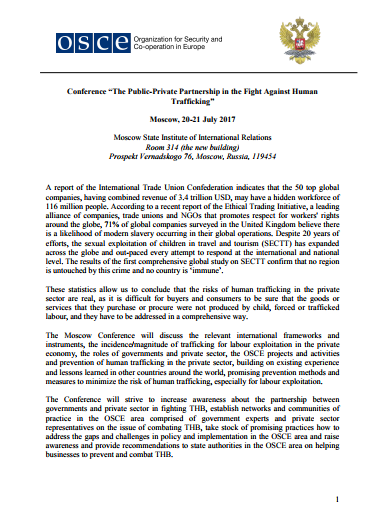
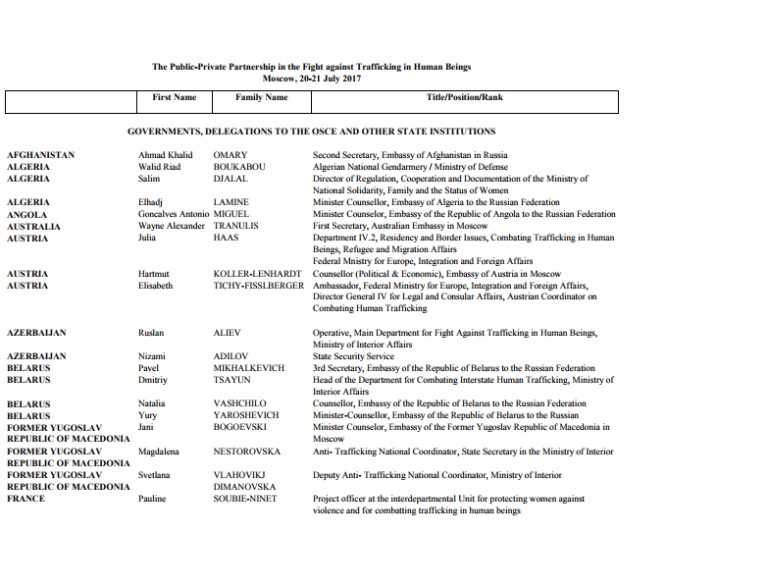
Organized by the OSCE Office of the Special Representative and Co-ordinator for Combating Trafficking in Human Beings (OSR/CTHB), in co-operation with the Ministry of Foreign Affairs of the Russian Federation, the Conference on “Public-Private Partnership in the Fight Against Human Trafficking” took place in Moscow, Russian Federation, on 20-21 July 2017 and focused on how the public and private sectors in the OSCE area and beyond could co-operate to prevent and combat Trafficking in Human Beings (THB).
The purpose of this OSCE wide conference is to discuss ways that governments and the private sector, as well as other civil society and international stakeholders, in the OSCE area and beyond can effectively partner to prevent and combat trafficking in human beings and the existing challenges and the opportunities in this regard. The conference presented promising practices, international and national legal frameworks regarding government obligations and businesses responsibilities vis-à-vis THB, as well as new trends and developments in this area. The Conference will focus on public-private partnership to fight THB, especially for child trafficking, labour and sexual exploitation, and other forms, and also on how private sector knowledge and expertise could provide solutions to governments’ task to prevent THB, including in the Information and Communication Technologies (ICT) field.
See here for more information about the conference and OSCE.
Report on “The Public-Private Partnership in the Fight Against Human Trafficking” Conference - OSCE, 2017DOWNLOAD
“The Public-Private Partnership in the Fight Against Human Trafficking” Conference - Annotated AgendaDOWNLOAD
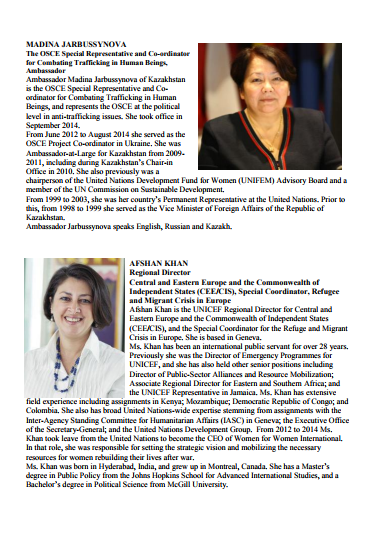
“The Public-Private Partnership in the Fight Against Human Trafficking” Conference - Speakers' BiographiesDOWNLOAD
“The Public-Private Partnership in the Fight Against Human Trafficking” Conference - Participants' ListDOWNLOAD
Watch Kyle Ballard's presentation "Zero, Some, or Zero-Sum: Exploring Trade-Offs in Identifying Human Trafficking Among Migration Flows" below. Kyle is the Senior Coordinator for Reports and Political Affairs in the U.S. Department of State’s Offi...Read More
This special issue of Anti-Trafficking Review bridges the fields of queer and transgender studies, migration studies, research on sex work, and critiques of the discourse on human trafficking. Along with centring LGBTQI+ subjects as actors within th...Read More
There is no procedure for the identification of victims of human trafficking which is independent of the criminal investigation. GRETA urges the Czech authorities to disconnect the identification of victims of human trafficking from the initiation o...Read More
This report provides the framework and resources necessary to understand the risk of human trafficking in global supply chains, and can help readers begin to assess the risk of human trafficking in particular federal supply chains. Later sections ex...Read More